You spent an evening tailoring your resume, hit submit, and heard nothing — not a rejection, just silence. Before you blame your experience, look at what hiring became in 2026: generative AI now writes, tailors, and even auto-submits job applications at industrial scale, and recruiters are drowning in the result. Job seekers call it ghosting. Recruiters call it the AI application flood, and it has quietly rewritten the rules of the job search.
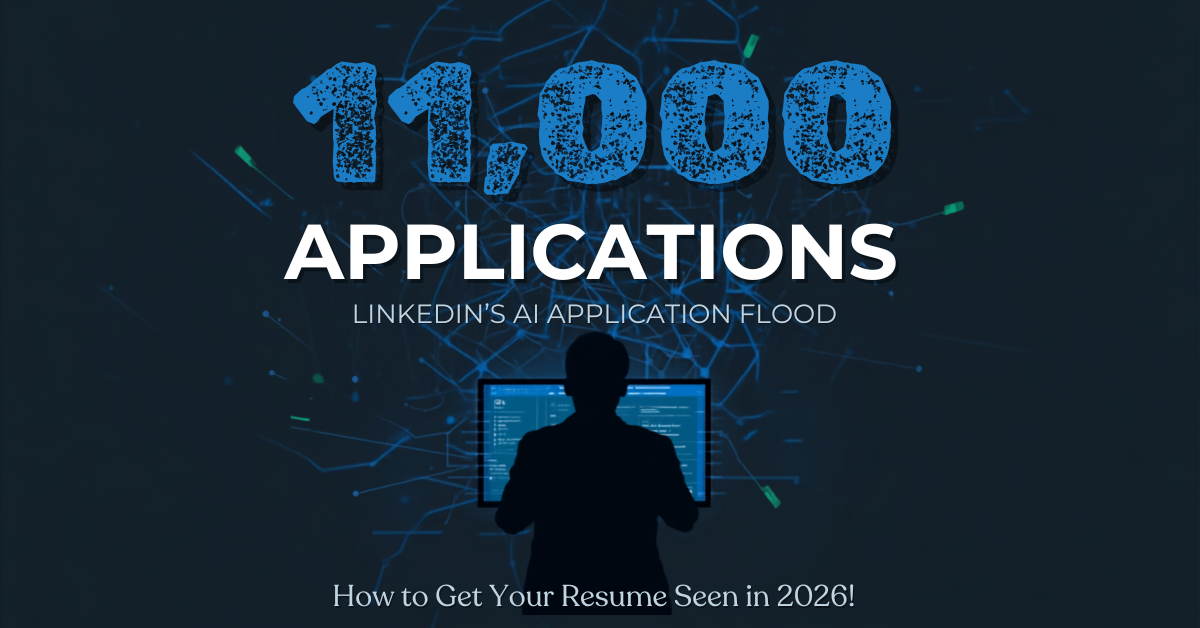
The numbers are hard to overstate. LinkedIn reports roughly 11,000 job applications submitted every minute on its platform — a 45% increase in a single year, driven largely by generative AI, according to LinkedIn data reported by The New York Times and eWeek. In the same reporting, one HR consultant received more than 1,200 applications for a single remote role — and ended up removing the posting entirely.
What Is the AI Application Flood?
The AI application flood is the surge of machine-generated resumes and cover letters that has overwhelmed online job boards since applying became nearly effortless. Candidates paste a posting into a chatbot, receive a polished-looking application, and fire it off — then repeat the process across every vaguely relevant role. Some tools even automate the clicking, applying to jobs while their owners sleep.
None of this reflects a hiring boom; it reflects how cheap applying became. And the catch is that everyone’s output looks alike. Recruiters interviewed in that reporting say AI-generated applications read nearly identically, which makes strong candidates harder to distinguish. The pile gets taller, the signal gets weaker, and your odds sink along with everyone else’s.
Why Mass Applying Stopped Working
Mass applying stopped working because AI now sits on both sides of the hiring process, and volume no longer buys visibility. When applying costs nothing, everyone applies to everything — so employers responded by automating their defenses.
LinkedIn itself introduced “Hiring Assistant,” an AI agent that screens candidates and messages applicants on recruiters’ behalf. That means your machine-written application is often read first by a machine. In this arms race, the generic candidate is invisible by design: when most of the pile sounds the same, sounding the same is a strategy for rejection.
This changes your goal. You are no longer trying to out-apply the market; you are trying to out-signal it. The rest of this guide shows you how.
Why You’re Being Ghosted
You’re being ghosted because the arithmetic of a flooded posting makes individual replies nearly impossible, not because your background is weak. Picture that remote role again: more than 1,200 candidates for one seat. No human can read a pile that size line by line, let alone respond thoughtfully to everyone in it.
So software makes the first cut, and it cuts deep. About 75% of resumes never reach a human reader because of ATS filtering — a bottleneck we break down in why most resumes never reach a human. Recruiters are not ignoring you personally; they are triaging inboxes that refill faster than they can be emptied.
Some employers give up altogether and, like that HR consultant, quietly take the posting down. Silence is not a verdict on your talent. It is simply what overload looks like from the outside.
The Quality-Over-Quantity Playbook
The playbook that wins in a flood is deliberately small: a handful of tailored applications beats a hundred generic ones. Every hour you save by not mass-applying goes straight back into the steps below.
- Choose fewer, better-fit roles. Apply only where you genuinely match the core requirements, and let the marginal ones go. Focus is the one thing the flood cannot fake.
- Mirror the job description’s exact keywords — honestly. If the posting says “stakeholder management,” use that precise phrase where it is true of you, and never claim a skill you cannot defend in an interview.
- Quantify achievements with your own real numbers. Pull results from work you actually did — revenue, users, hours saved — instead of borrowing impressive-sounding figures from templates. Specifics are your fingerprint.
- Keep your LinkedIn consistent with your resume. Recruiters cross-check titles, dates, and skills, and unexplained mismatches quietly end candidacies before a conversation ever starts.
- Bring proof of work. A portfolio, a live project, or a short case study is evidence a mass applicant never bothers to attach — and evidence is exactly what a skeptical reviewer wants.
How to Be Machine-Readable and Human-Worthy
Your application now has to clear two very different gatekeepers in sequence: parsing software that reads structure and keywords, and a human reviewer who is increasingly allergic to machine-written text. Optimizing for only one of them is how good candidates fail.
The human filter is harsher than most job seekers realize. In a TopResume survey of 600 U.S. hiring managers, 33.5% said they can spot an AI-generated resume within seconds, and roughly 1 in 5 will reject a candidate over it — the quality-side backlash we unpack in our report on the AI-slop resume backlash. This article is the volume side of that same story, and you need to survive both.
- Use a clean, single-column layout with standard section headings so any ATS can parse every line.
- Skip tables, text boxes, icons, and graphics that scramble automated parsing.
- Work the posting’s skills and titles into your summary and experience — wherever they are genuinely true.
- Use AI as an editor, not a ghostwriter: draft every bullet in your own words first, then tighten it.
- Cut template phrases like “results-driven professional” and replace them with specifics only you could write.
For the full formatting checklist, follow our ultimate ATS-friendly resume guide before you submit anything else.
The Channels That Bypass the Flood
Referrals, direct outreach, and early applications put your name in front of a decision-maker before the algorithmic pile forms. Treat the apply button as one channel among several — never as the whole strategy.
Ask for a Referral First
A referral routes your resume around the stack instead of into it. Before applying anywhere, check whether anyone in your network works at the company — or knows someone who does — and ask for a warm introduction with one sentence on why you fit. Referred candidates enter the process with borrowed trust, the scarcest resource in an AI-flooded market.
Write Directly to the Hiring Manager
A short, specific message to the hiring manager can register your name before screening even begins. Name the role, connect one real achievement to a problem they are hiring to solve, and close with a low-pressure question. In a flooded inbox, brief and specific beats long and generic every time.
Apply Early, Before the Pile Grows
The moment a posting goes live is the moment your application faces the least competition. Set alerts for your target companies and act the day a role appears, because overloaded employers sometimes pull listings entirely — exactly as that 1,200-application posting vanished.
The Bottom Line
The AI application flood rewards the few candidates who refuse to fight volume with volume. With roughly 11,000 applications a minute pouring into LinkedIn alone, one more generic blast just feeds the pile, while a tailored, honest, evidence-backed application delivered early — or through a referral — still gets read. Pick your targets, mirror the posting’s language, prove your claims, and reach the human behind the role. Then make the document itself flawless: tailor an ATS-ready resume in minutes with Clever CV’s AI resume builder.