There is a backlash building against the “AI slop” resume — the generic, machine-written application that floods inboxes and reads like every other one. In 2026, the very tools that were supposed to make job hunting easier have made standing out harder, and recruiters are pushing back.
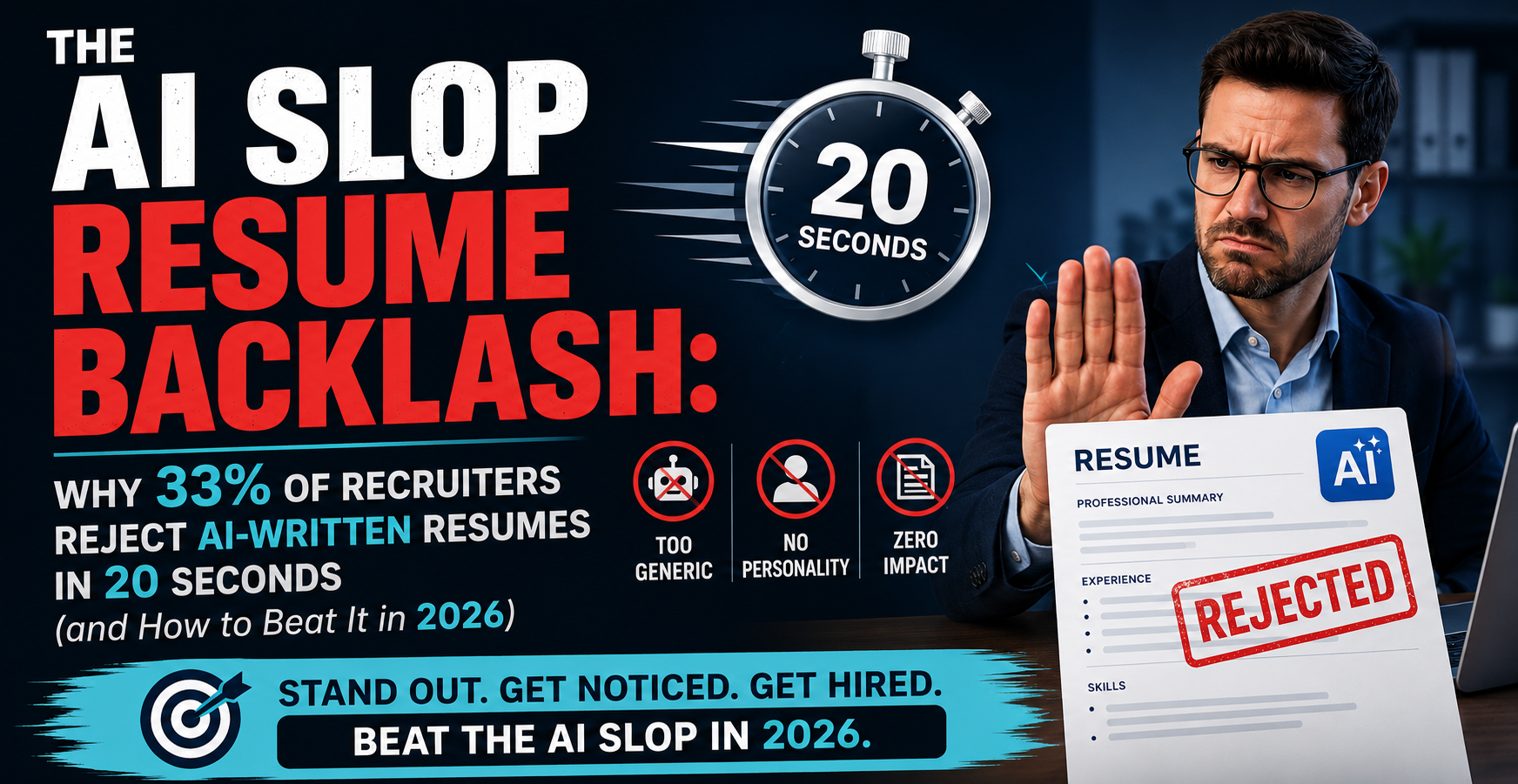
The data backs up the shift. In a TopResume survey of 600 U.S. hiring managers (May 2026, reported by the U.S. Chamber of Commerce), 33.5% said they can spot an AI-generated resume quickly — often within about 20 seconds. Roughly one in five would reject a candidate whose resume or cover letter was AI-generated, and a similar share treat heavy reliance on AI as a red flag. The takeaway is blunt: if your application reads like a robot wrote it, a human may never finish reading it.
What “AI Slop” Actually Looks Like
“AI slop” is the recruiter’s shorthand for the telltale fingerprints of an unedited language model: vague superlatives, hollow phrasing, and the same handful of buzzwords repeated across hundreds of applications. When every resume claims to be a “results-driven, detail-oriented professional with a proven track record,” none of them stand out.
The problem is one of scale. LinkedIn reports roughly 11,000 job applications submitted per minute — a record high. When AI lets anyone fire off dozens of applications in an afternoon, the volume explodes and the signal-to-noise ratio collapses. Recruiters are not reading more carefully; they are scanning faster and rejecting harder.
The Tells Recruiters Notice First
- Generic openings. A cover letter that could be addressed to any company at any time is an instant tell.
- Buzzword density. “Synergy,” “leverage,” “dynamic,” and “passionate” stacked together signal autopilot writing.
- No specifics. AI fills space with adjectives; humans remember numbers, names, and outcomes. The absence of concrete detail is the loudest signal of all.
- Uniform rhythm. Every bullet the same length, every sentence the same cadence — real careers are messier than that.
Recruiters Are Not Anti-AI — They Are Anti-Lazy
Here is the nuance that matters: the backlash is not against the technology itself. In the same TopResume survey, 52% of hiring managers said they accept AI for proofreading or drafting — as long as the final result reads as genuinely human. The line is not “did you use AI?” It is “did you bother to make it yours?”
That distinction is everything. AI used as a first draft, then heavily edited with your real voice, specific achievements, and the language of the actual job description, is fine. AI used as the final draft — copied, pasted, and submitted — is what triggers the rejection reflex.
How to Use AI Without Producing Slop
- Draft, don’t dictate. Let AI structure a starting point, then rewrite it in your own words. If you would not say it out loud in an interview, cut it.
- Add what AI cannot invent. Real metrics, real project names, real problems you solved. Specificity is the antidote to slop.
- Mirror the role, not a template. Tailor every application to the specific posting. A targeted, human-edited resume beats fifty generic blasts.
- Read it aloud. If it sounds like a press release instead of a person, keep editing.
The Squeeze Is Worst for Early-Career Candidates
New graduates are feeling the AI shift most sharply — on both sides of the desk. Research from the Stanford Digital Economy Lab (“Canaries in the Coal Mine?”, November 2026) found that early-career workers aged 22–25 in the most AI-exposed occupations saw a 16% relative decline in employment since generative AI adoption took hold, while more experienced workers and those in less-exposed fields stayed stable or grew.
For younger candidates, that means two pressures at once: fewer entry-level openings, and stiffer competition for the ones that remain. Leaning on AI to mass-produce applications feels efficient, but it is exactly the strategy recruiters have learned to filter out. The candidates who break through are the ones who slow down and sound like themselves.
AI Is Now on the Other Side of the Table Too
The backlash runs in both directions. Candidates are increasingly meeting AI not just in resume screening, but in the interview itself. According to the Greenhouse 2026 Candidate AI Interview Report (a survey of 2,950 active job seekers across the US, UK, Ireland, Germany, and Australia), 63% of job seekers have already experienced an AI interview — up 13 percentage points in just six months.
That cuts both ways. Just as recruiters resent slop resumes, candidates resent feeling processed by a machine. The mutual frustration is reshaping expectations: a Gartner survey of 3,000 candidates found that 62% are more likely to apply when an employer requires in-person interviews, and only 26% trust AI to evaluate them fairly. Gartner also projects that 1 in 4 candidate profiles will be fake by 2028 — a flood of synthetic applicants that makes authentic, human-sounding ones more valuable, not less.
The Trust Deficit Behind the Backlash
The AI-slop backlash sits inside a wider collapse of trust in hiring. Greenhouse’s State of Job Hunting research found that 61% of job seekers have been ghosted after an interview and 79% report heightened job-market anxiety, with an estimated 18–22% of postings each quarter behaving like “ghost jobs.” When candidates feel the process is impersonal and stacked against them, the temptation to automate their side of it grows — and the slop spiral accelerates.
Breaking out of that spiral is the opportunity. The signal that works in 2026 is the one machines cannot fake at scale: a specific, honest, human application aimed at a real role you actually want.
What Still Beats the Algorithm
Despite all the AI on both sides, the fundamentals have not changed. Roughly 98% of Fortune 500 companies use an Applicant Tracking System (ATS), according to Jobscan, so your resume still has to be machine-readable before it ever reaches a human. The goal is to satisfy the parser without sounding like one.
- Use the job’s real keywords — but in sentences a person would actually write.
- Keep formatting clean and standard so the ATS can parse it, then make the words unmistakably yours.
- Quantify honestly. Concrete results pass both the algorithm and the recruiter’s “is this real?” test.
- Tailor over volume. In a world of 11,000 applications a minute, one well-aimed application outperforms a hundred generic ones.
The Bottom Line
The AI-slop backlash is not a reason to abandon AI — it is a reason to use it like a professional instead of a shortcut. With 33.5% of hiring managers able to spot AI writing in seconds and roughly one in five willing to reject over it, the winning move in 2026 is the same as it has always been: sound like a real person who genuinely wants the job. Use tools like Clever CV to build a clean, ATS-ready foundation — then make every word yours.
You can read the underlying survey reporting on AI-generated resumes via the U.S. Chamber of Commerce here: How Hiring Managers Are Responding to AI in Job Applications.