Job seekers submit an average of 42 applications to land a single interview. If you are sending resumes into the void and hearing nothing back, the problem is rarely your qualifications. It is how your resume communicates them. This guide helps you diagnose exactly what is wrong and shows you how to fix it.
How Long Recruiters Actually Spend on Your Resume
A study of 4,289 resume reviews found the average initial scan time is 11.2 seconds. In high-volume hiring, it can drop to 6-7 seconds. If you pass the initial scan, the median total review time is 1 minute and 34 seconds, during which recruiters verify quantifiable results and role titles.
What this means: Your resume has roughly 10 seconds to make a first impression. The top third (name, summary, most recent role) is the most critical real estate on the page.
Top Reasons Resumes Get Rejected
1. Not Customized to the Job (73% Rejection Rate)
73% of resume rejections happen because work experience does not match what the job asks for. 54% of candidates do not tailor their resume to the job description. Meanwhile, 72% of recruiters reject resumes that are not customized to the specific role.
The fix: Candidates who tailor their resumes report a 3x increase in interview invitations. Mirror exact language from the job posting. Reorder bullets to highlight relevant experience first. Adjust your summary for each application.
2. Listing Duties Instead of Achievements
The single biggest content mistake. Every marketing manager "manages social media accounts." That does not differentiate you. Recruiters want to see what you accomplished, measured in numbers.
Before: "Responsible for social media management"
After: "Increased Instagram engagement by 42% through targeted content strategy, growing follower base from 800 to 12K in 6 months"
Before: "Managed department budget"
After: "Reduced operational costs 18% through process optimization, saving $156,000 annually"
Before: "Provided patient care"
After: "Maintained 98% patient satisfaction score while reducing average wait times from 27 to 12 minutes"
3. Grammar and Spelling Errors (77% Rejection Rate)
77% of hiring managers would dismiss a resume with grammar or spelling mistakes. 59% of recruiters reject outright for typos. ATS does not interpret intent either: misspelled keywords are simply missed by the system.
The fix: Use a grammar checker, then have at least two other people proofread your resume. Read it backwards to catch errors your brain auto-corrects.
4. Poor Formatting (68% Rejection Rate)
68% of hiring managers reject candidates for poorly formatted resumes. Tables, text boxes, columns, graphics, and headers/footers all break ATS parsing. Dense walls of text with no white space get skipped by humans.
The fix: Single-column layout, standard fonts (Arial, Calibri, Times New Roman at 11-12pt), consistent formatting throughout, adequate white space, and standard bullet points.
5. Generic or No Professional Summary
Resumes with professional summaries receive 340% more interview callbacks than those with traditional objectives. If your summary reads "Hardworking professional seeking growth opportunities," it is hurting you more than helping.
Before: "Experienced professional seeking growth opportunities in a challenging environment."
After: "PMP-certified Project Manager who delivered 15 cross-functional projects worth $5.2M collectively, averaging 7% under budget and 10 days ahead of schedule."
6. AI-Generated Content Without Personalization
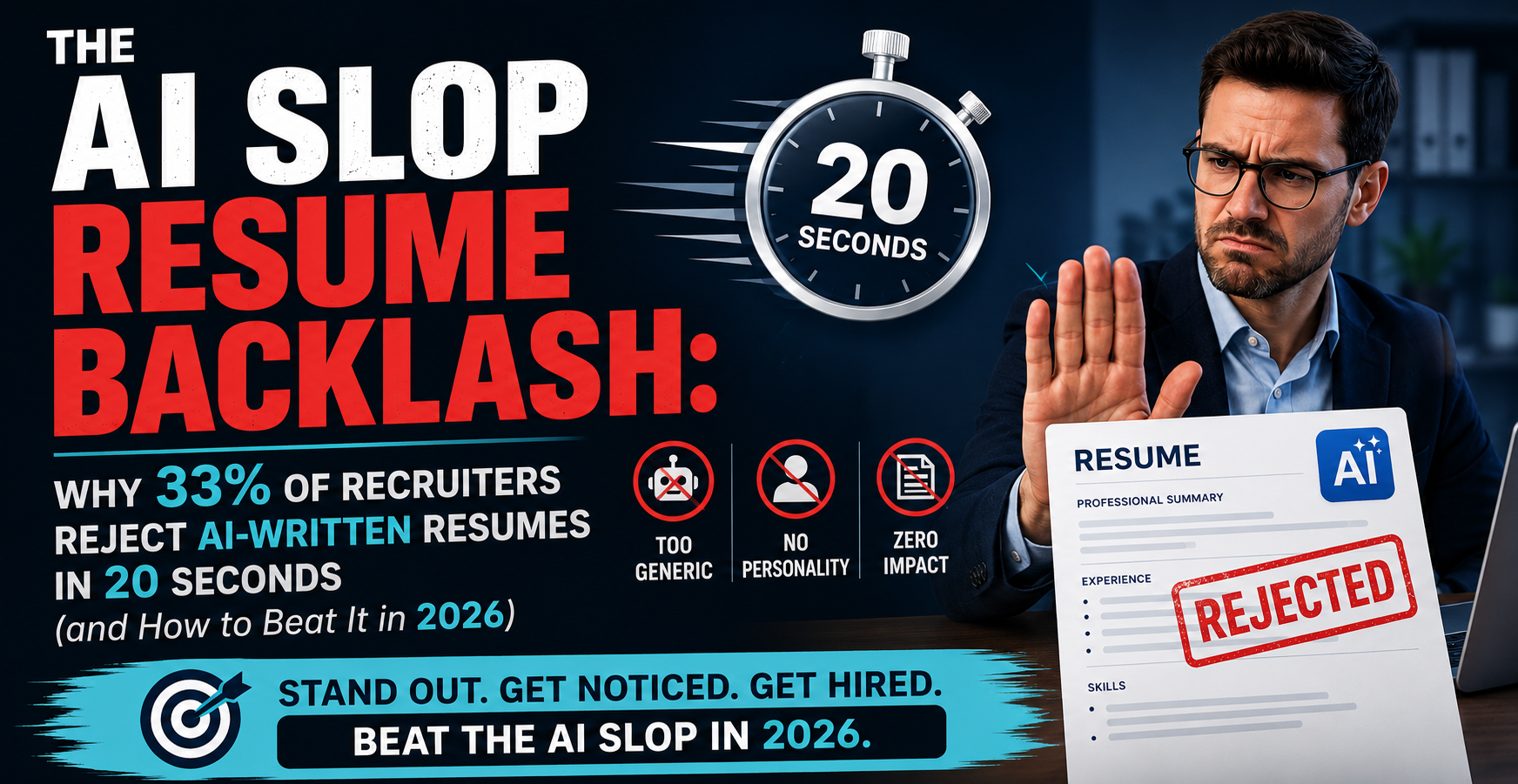
62% of employers say AI-generated resumes without customization are more likely to be rejected. 53% of hiring managers flag this as the biggest resume red flag in 2026. AI tools can help draft content, but generic AI output without personal details and specific achievements gets noticed and penalized.
Diagnose Your Resume: The Response Rate Test
Track your application-to-interview ratio to gauge where your resume stands:
- Below 5%: Serious problems. Likely ATS formatting issues, missing keywords, or fundamental content weaknesses. Consider a full rewrite.
- 5-10%: Moderate issues. Needs better targeting and tailoring per job.
- 10-20%: Average. Room for improvement in specifics and metrics.
- 20-30%: Good. Fine-tuning will help.
- Above 30%: Strong resume performance.
The ATS Reality Check
The widely circulated claim that "75% of resumes are auto-rejected by ATS" originated from a 2012 sales pitch with no research methodology. 92% of recruiters confirm their ATS does not auto-reject resumes.
But ATS does rank and sort. 88% of employers believe qualified candidates are screened out because of formatting issues, not qualifications. Here is how to ensure your resume parses correctly:
- Submit as .docx (universally parseable by all ATS)
- Use standard section headings: "Work Experience," "Education," "Skills"
- Place contact info in the document body, not headers/footers
- Avoid tables, text boxes, graphics, and multi-column layouts
- Include exact keywords from the job posting in your summary, skills section, and experience bullets
Quick test: Paste your resume into a plain text editor. If sections appear jumbled, dates are misplaced, or text is missing, ATS will struggle with it too.
Red Flags That Turn Off Recruiters
- Unprofessional email address — 76% rejection rate
- Dishonesty or inconsistencies — If your resume says one thing and your LinkedIn says another, it looks like misrepresentation
- Inflated titles — Two years of experience with "Head of Operations" raises immediate suspicion
- Job hopping — 50% of hiring managers are hesitant about frequent changes every 1-2 years
- Outdated resume objective — Instead of a professional summary
- Walls of text — No bullet points, no white space, no visual hierarchy
- Irrelevant information — Hobbies, ancient jobs, and unrelated experience waste space
When to Tweak vs. Completely Rewrite
A quick tweak is enough when:
- You received a new certification or promotion
- You need to add a recent role or adjust bullet points
- You are applying to a similar role in the same industry
You need a full rewrite when:
- Your resume has structural or formatting issues (tables, columns, graphics)
- You are changing industries or career paths
- You have not updated in 2+ years
- Your resume focuses on duties rather than accomplishments
- Your response rate is below 5% after 20+ applications
- You still use an objective statement instead of a professional summary
Your Resume Fix Action Plan
Today:
- Run your resume through an ATS compatibility test
- Fix formatting: single column, standard fonts, no graphics
- Replace your objective with a professional summary
This week:
- Rewrite your top 5 bullet points using the Action + Metric + Impact formula
- Remove irrelevant information and outdated roles
- Have two trusted people proofread it
Per application:
- Tailor keywords to the specific job description
- Apply within the first 24-48 hours of a job posting
- Track your response rate to measure improvement
The Resume Self-Review Checklist
- Professional summary with quantified achievements at the top
- Every bullet point starts with a strong action verb
- Quantifiable metrics in at least 50% of bullet points
- Customized for the specific job description
- Keywords from the posting appear naturally throughout
- Single-column, ATS-friendly formatting
- Standard fonts, consistent formatting, adequate white space
- Zero spelling or grammar errors
- Professional email address
- LinkedIn profile matches resume claims
- Tested in plain text editor for ATS readability
- Every bullet answers "So what?" with a concrete impact
Stop Applying, Start Landing Interviews
If your resume is not getting interviews, it is not a reflection of your value as a professional. It is a communication problem, and communication problems have solutions. Diagnose the issue using the response rate test, fix the specific weaknesses this guide identified, and start tracking your results. The candidates who land interviews are not always the most qualified. They are the ones whose resumes make their qualifications impossible to ignore.