For decades, European employers held every card in the salary conversation. They knew the role’s real budget, what the last hire accepted and what you earned in your previous job—while you guessed, undersold yourself or got screened out for naming the “wrong” number. That imbalance is now collapsing. The EU Pay Transparency Directive has moved from legislative text to hiring-room reality, and salary secrecy is being dismantled across the world’s largest single market.
Here is the short version. Directive (EU) 2023/970, adopted in 2023, gave all 27 EU member states until 7 June 2026 to transpose pay transparency into national law. Job applicants gain the right to see a role’s initial pay or pay range—in the posting itself or at the latest before the first interview—and employers are banned from asking about salary history. As of mid-June 2026, four countries—Italy, Slovakia, Lithuania and Malta—had full implementing laws in force, most others had partial measures, and employers with 250+ employees must begin gender pay-gap reporting in 2027. This guide explains what changed, where it applies and how to convert it into a higher offer.
What Is the EU Pay Transparency Directive?
The EU Pay Transparency Directive—formally Directive (EU) 2023/970—is a European law adopted in 2023 that requires every member state to give job applicants and workers enforceable rights to pay information. Its goal is to turn equal pay for equal work, or work of equal value, into something you can verify with real numbers rather than a principle you take on faith.
One legal nuance matters enormously for your job search: this is a directive, not a regulation that switched on everywhere at once. Each of the 27 member states had to transpose it into its own national law by 7 June 2026, so the rules arrive country by country, at different speeds and with local variations. The European Commission marked the deadline by publishing an official explainer of the new pay transparency rules in June 2026.
Your New Rights as a Job Applicant
As a candidate, you gain a set of concrete new rights at the hiring stage, and they apply to employers of all sizes—from young startups to multinationals.
- A pay range before your first interview. You have the right to know the initial pay or pay range for the role, either in the job posting itself or, at the latest, before the first interview takes place.
- No salary-history questions. Employers are banned from asking what you currently earn or what you were paid in past roles, which stops an old, low salary from following you into every new offer.
- Gender-neutral pay criteria. The pay or range must be set on objective, gender-neutral criteria, so the number reflects the value of the role rather than assumptions about the person filling it.
Transparency does not stop once you sign. Workers gain the right to request the average pay levels, broken down by sex, for categories of workers doing the same work or work of equal value—a powerful benchmark for your first internal raise conversation.
Where the Directive Is Actually in Force Right Now
As of mid-June 2026, only four member states—Italy, Slovakia, Lithuania and Malta—had full implementing laws in force, according to the Remote Work Europe transposition tracker. Most other countries had partial measures in place, and those typically cover what matters most to job seekers first: recruitment-stage transparency and bans on salary-history questions.
Missing the deadline is not cost-free for governments. The European Commission can open infringement procedures against member states that fail to transpose the directive, which keeps pressure on the laggards. For you, the practical rule is simple: check your target country’s rollout status before you apply, because a right you can insist on in Italy may still be moving through parliament somewhere else.
Why the EU Ended Salary Secrecy
The EU acted because the gender pay gap refused to close on its own: women in the EU still earn on average about 13% less per hour than men, according to the European Commission. Equal-pay principles have long existed on paper, but you cannot challenge a gap you cannot see—so the directive attacks the secrecy that allowed unequal pay to survive.
Reporting, joint assessments and the burden of proof
Inside companies, transparency becomes measurable. Employers with 250+ employees must begin gender pay-gap reporting in 2027, with smaller employers phased in over the following years. If reporting reveals an unjustified gender pay gap above 5%, the employer must carry out a joint pay assessment with workers’ representatives to diagnose and correct it.
The directive also rebalances disputes. In pay-discrimination claims, the burden of proof shifts toward the employer, and underpaid workers can claim back pay. Quietly underpaying someone has changed from a savings line into a legal and financial risk—which is exactly why employers are becoming more careful about how they set and explain salaries.
The Negotiation Playbook: Turning Mandatory Ranges Into a Higher Offer
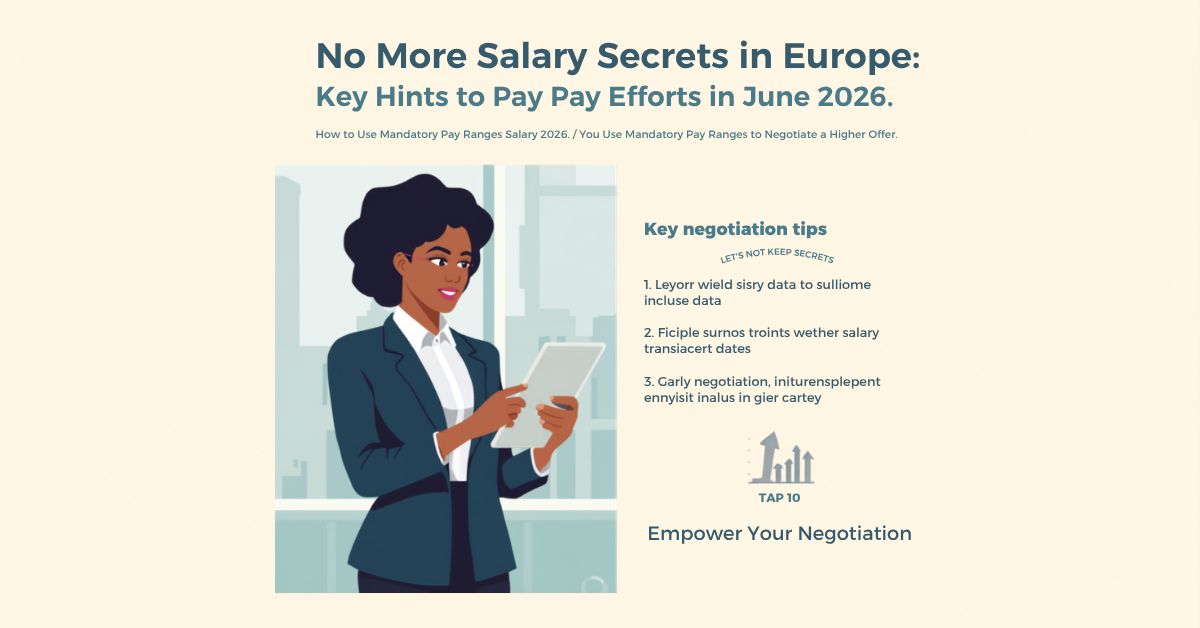
To use mandatory pay ranges to earn more, treat every published range as the opening of a negotiation, not the end of one. A range is the employer telling you, in writing, what the role is worth—your job is to prove you belong in its upper portion.
- Benchmark before you apply. Research the posted range against similar roles at competing employers. If it sits below the market, negotiate harder or keep looking; if it sits high, invest serious effort in that application.
- Anchor near the top—with evidence. When asked about expectations, name a figure in the upper part of the published range and tie it to impact: revenue you grew, costs you cut, projects you delivered. An anchor backed by proof is hard to dismiss.
- Ask when the range is missing. Where the rules are in force, you may request the pay range before the interview if the posting omits it. A polite note works: “Could you share the pay range for this role ahead of our conversation?”
- Decline salary-history questions. If anyone asks what you currently earn, you can politely refuse: “I’d rather focus on the value I can bring—the published range is the right basis for this conversation.” Across much of the EU, the question itself is now banned.
For counter-offer scripts, timing tactics and handling competing offers, see our complete guide to salary negotiation strategies.
What It Means for Non-EU and Remote Candidates
If you apply remotely to an EU-based employer, the employer’s rules cover you—these rights attach to where the company hires, not to your passport or time zone. That makes transparent European employers unusually attractive for remote candidates worldwide, because you can see the money before you invest time in interviews.
Applying from outside Europe
Candidates in the Middle East, Africa, Asia or the Americas can run the same playbook when targeting EU employers: read the posted range, benchmark it, anchor high and never volunteer salary history. Because implementation differs by country, check your target market’s status first—then present yourself the way European recruiters expect with our guide to the European CV format and Europass.
The Bottom Line
Pay transparency has shifted real leverage toward candidates in Europe. Directive (EU) 2023/970 gives you a pay range before the first interview, bans salary-history questions and forces employers to measure and justify pay gaps—even if, as of mid-June 2026, only four countries had implemented it in full while the rest catch up.
Information only pays when you act on it. Benchmark every range, anchor high with evidence and refuse to let an old salary define your next one—then pair your negotiation edge with an interview-winning application built in Clever CV’s AI resume builder.