You spend an evening tailoring your resume, rewriting your cover letter, and answering screening questions—then hear nothing. Not because you weren’t qualified, but because nobody was ever going to be hired. Welcome to the era of ghost jobs: real-looking postings from real companies with no genuine hiring intent behind them, quietly draining job seekers’ time across every major job board.
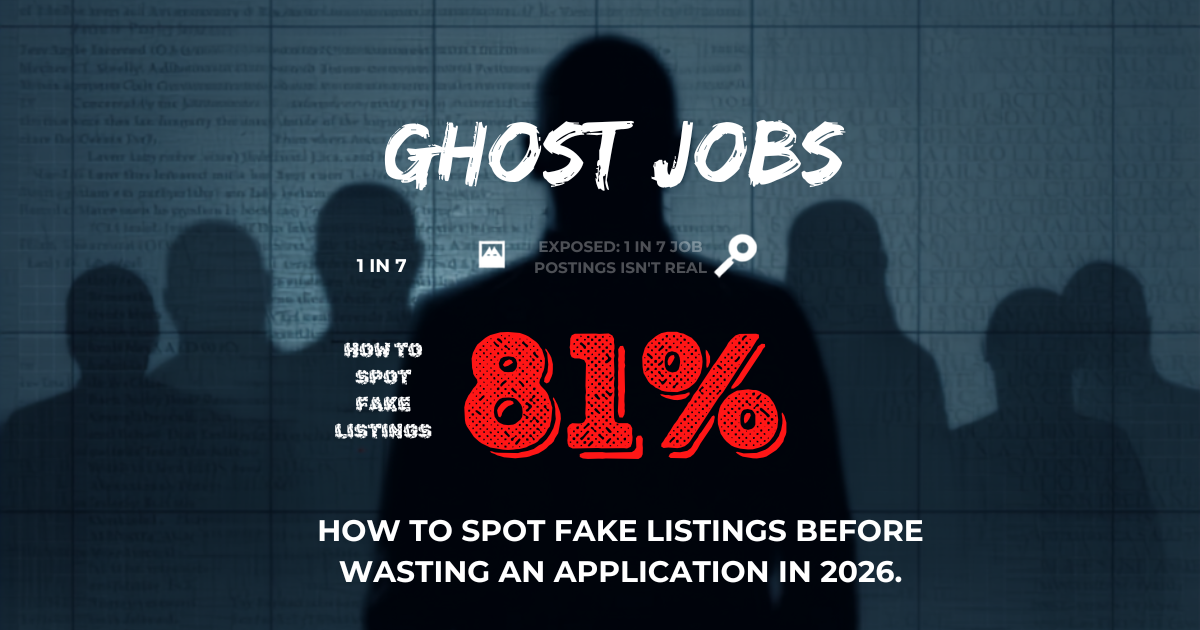
The data confirms what frustrated applicants have long suspected. An April 2026 Clarify Capital study that analyzed more than 175,000 U.S. job listings found that 1 in 7 active postings is a ghost job—flagged because it stayed live for over 30 days with no real hiring intent. A MyPerfectResume survey found 81% of recruiters admit their employer has posted ghost jobs, and a separate analysis reported by Entrepreneur found that roughly 1 in 4 U.S. listings on LinkedIn—about 27%—show ghost-job characteristics. If your job search feels like shouting into the void, the void is real.
What Is a Ghost Job?
A ghost job is a job posting published by a real company with no genuine or immediate intention of filling the role. The listing looks legitimate—an actual employer, a plausible title, a polished description—but applications flow into a pipeline nobody is actively reviewing. In the Clarify Capital study, researchers flagged postings that stayed active for more than 30 days while showing no real hiring intent.
Ghost jobs are different from outright scams. A scam tries to steal your data or your money; a ghost job simply wastes your time—which, in a competitive market where every tailored application costs you hours, can be nearly as damaging.
How Common Are Ghost Jobs in 2026?
Ghost jobs now make up 1 in 7 active U.S. job postings, according to Clarify Capital’s April 2026 analysis of more than 175,000 listings. And the problem is not confined to one platform: a separate data analysis reported by Entrepreneur found that roughly 1 in 4 U.S. job listings on LinkedIn—about 27%—display ghost-job characteristics.
The macro trend backs this up. The hires-per-posting ratio has roughly halved since 2019, falling from about 8 hires per 10 postings to about 4 per 10. More ads, fewer actual hires: the visible job market is significantly inflated, and applicants are paying the price in wasted effort.
Which Industries Post the Most Ghost Jobs?
Some sectors are far worse offenders than others. In the same study, ghost-job rates reached 51% in wholesale, 48% in mining, 43% in biotechnology, 37% in e-commerce, and 35% in sustainability. If you’re hunting in one of these industries, verification isn’t optional—it’s survival.
Which Seniority Levels Are Hit Hardest?
Leadership roles are surprisingly exposed. Ghost-job rates hit 21% for senior-level roles, 18% at VP level, 17% in the C-suite, and 15% for manager-level positions—so even seasoned executives are chasing phantoms alongside entry-level candidates.
Why Do Companies Post Jobs They Never Intend to Fill?
Companies post ghost jobs to stockpile talent, signal growth, calm overstretched teams, and gather market intelligence—not to hire anyone right now. In an earlier Clarify Capital survey from 2026, nearly 1 in 3 employers admitted posting jobs with no current intent to hire. And when MyPerfectResume asked recruiters directly, 81% admitted their employer has posted ghost jobs.
The motives are strategic, not accidental:
- Building a talent pipeline so resumes are already on file when a role eventually opens.
- Projecting growth to investors, competitors, and the wider market.
- Motivating or placating overworked staff with the visible promise that help is on the way.
- Collecting salary and market data from applicants’ expectations and profiles.
Notice that none of these reasons involves you actually getting hired. That’s exactly why you need a detection system before you invest another evening in an application.
The Red Flags: How to Spot a Ghost Job Before You Apply
The most reliable ghost-job red flags are a stale or endlessly reposted listing, vague details, and a role you can’t find on the company’s own website. Run every posting through this checklist before you commit your time:
- It’s older than 30 days—or keeps getting reposted. Clarify Capital used the 30-day mark as a core ghost-job signal. A listing that vanishes and reappears on a cycle is recycling resumes, not recruiting.
- Vague responsibilities. Real openings describe specific projects, tools, and outcomes. Ghost jobs read like generic templates because no hiring manager wrote them for a real need.
- No salary range. Employers hiring with urgency increasingly publish pay to attract candidates; a missing range—especially where disclosure is expected—signals low commitment.
- The role isn’t on the company’s careers page. If a job lives on LinkedIn but not on the employer’s own site, treat it as unverified until proven otherwise.
- The company recently announced layoffs or a hiring freeze. New postings that contradict recent news are usually pipeline-building or investor optics.
- The recruiter can’t answer timeline questions. Vague replies about interview stages, start dates, or headcount approval are a classic tell.
- Evergreen “always hiring” titles. Perpetual openings for the same generic role often exist purely to collect resumes year-round.
How to Verify a Job Listing Is Real Before You Apply
You can verify a listing’s legitimacy with a short pre-application check that costs far less than a wasted application. Work through these steps in order:
- Check the posting date and repost history. Search the exact title and company together; if the same ad has been cycling for months, push it down your priority list.
- Cross-check the company’s careers page. A genuine opening almost always appears on the employer’s own site with a matching requisition.
- Scan recent company news. Layoffs, hiring freezes, or budget cuts announced recently are a strong contradiction signal—proceed with caution.
- Message the recruiter or hiring manager. Ask directly: “Is this role actively being filled?” and “What does the hiring timeline look like?” Silence or vagueness is your answer.
- Look for signs of real hiring activity. New team members announcing they’ve joined, active interview chatter, or a named hiring manager on the posting all suggest genuine intent.
Are Ghost Jobs Even Legal?
Posting a ghost job is currently legal in most of the United States—but regulators are catching up. In May 2026, state lawmakers began introducing bills aimed at curbing ghost job ads, as reported by Forbes. The proposals take aim at stale listings and postings without genuine openings, a sign that the practice is now under real legislative scrutiny.
Until those rules take effect, though, enforcement is on you. Assume no job board is filtering ghost jobs on your behalf, and vet accordingly.
What Ghost Jobs Mean for Your 2026 Search Strategy
Ghost jobs mean the advertised market is smaller than it looks, so high-volume applying is a losing strategy. Here’s the irony: while many advertised jobs aren’t real, many real jobs are never advertised at all. That flip side is the hidden job market, and it rewards networking, referrals, and direct outreach far more than mass applications ever will.
So prioritize fresh, verified postings, and channel the rest of your energy into direct contact with hiring managers. And if you’re confident the roles you’re targeting are real but you’re still not hearing back, the problem may be closer to home—here’s why your resume isn’t getting interviews and how to fix it.
The Bottom Line
Ghost jobs are a structural feature of the 2026 job market, not a rare annoyance: 1 in 7 postings isn’t real, 81% of recruiters admit their companies have posted them, and lawmakers are only beginning to respond. You can’t change any of that—but you can stop feeding the machine your evenings.
Vet every listing against the checklist above, favor fresh and verifiable openings, and redirect the hours you save into applications that actually count. Then make each one land: build an ATS-ready resume in minutes with Clever CV’s AI resume builder.