If you graduated recently and your applications keep disappearing into the void, it is not in your head. Entry-level roles have absorbed the hardest blow from the move to AI-driven work, and the resume tactics that worked a few years ago can now get you screened out faster than ever. The good news: the fix is not to fight AI or to hide that you used it. It is to use it the way recruiters actually accept, and to lead with the human signal they are desperately looking for.
Below, every number is tied to a named, published source. No invented statistics, no vague "studies say." Just what the research actually shows and what to do about it.
Why New Grads Are Getting Hit Hardest
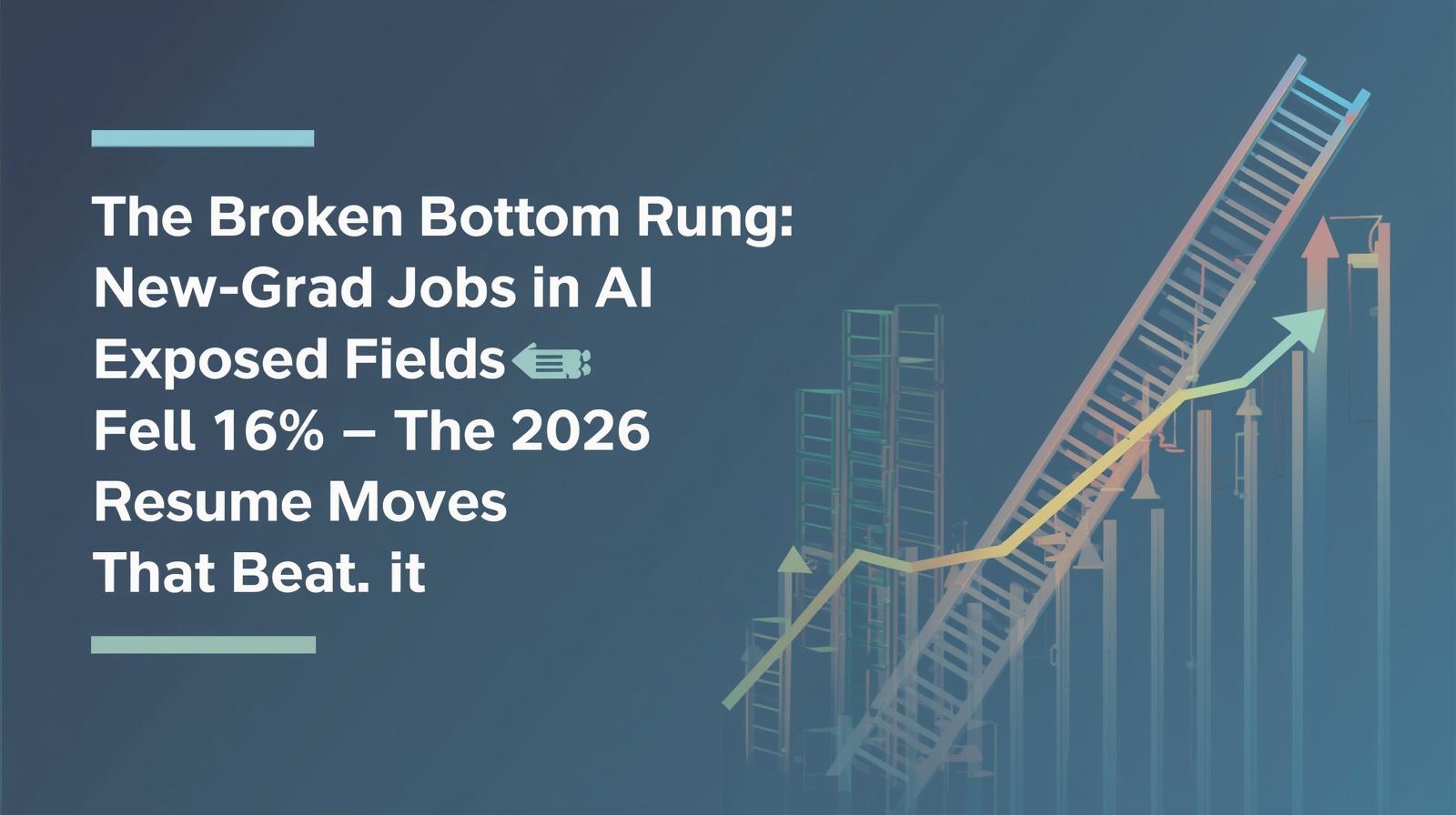
The single most important finding for early-career job seekers comes from Stanford's Digital Economy Lab. In their 2026 study "Canaries in the Coal Mine?", researchers Erik Brynjolfsson, Bharat Chandar, and Ruyu Chen found that workers aged 22 to 25 in the most AI-exposed occupations saw a 16% relative decline in employment since generative AI was widely adopted. Meanwhile, experienced workers and people in less-exposed fields stayed stable or kept growing.
Read that carefully: the damage is concentrated at the entry level, in exactly the jobs many new graduates target first. The roles that used to be the on-ramp to a career are the ones AI is reshaping fastest. That is the crisis. The rest of this guide is the response.
It Is Also Just More Crowded
Part of why your application feels invisible is sheer volume. LinkedIn has reported a record pace of roughly 11,000 job applications submitted every minute. When a single posting draws hundreds or thousands of resumes, the screening filters get harsher and your margin for error shrinks. Standing out is no longer optional.
Recruiters Can Tell When AI Wrote Your Resume
Here is the trap most new grads fall into: they paste the job description into an AI tool, accept whatever comes out, and submit it. Recruiters notice. A TopResume survey of 600 U.S. hiring managers (May 2026, reported by the U.S. Chamber of Commerce CO—) found that about one in three hiring managers (33.5%) say they can spot an AI-generated resume quickly, often within roughly 20 seconds. You can read the breakdown on the U.S. Chamber of Commerce CO— report.
And spotting it is not harmless. In the same survey:
- Around one in five hiring managers (~20%) would reject a candidate whose resume or cover letter was clearly AI-generated.
- About one in five (~20%) treat heavy reliance on AI as a red flag about the candidate.
- But here is the opening: 52% are fine with AI for proofreading or drafting — as long as the final result reads as genuinely human.
That 52% is the whole strategy in one number. AI is allowed. Generic, obviously-AI output is not. Your job is to use the tool and then make the result sound like a person who actually did the work.
The Resume Strategy That Still Works
1. Use AI as a Draft Assistant, Then Rewrite It in Your Voice
Let AI structure bullet points and fix grammar. Then go line by line and replace the polished, hollow phrases with specifics only you could write: the tool you actually used, the result you actually got, the problem you actually solved. If a sentence could appear on any stranger's resume, it is doing nothing for you.
2. Make Every Bullet Concrete
- Name real tools and technologies. "Built a sales tracker in Excel and Python" beats "leveraged data-driven solutions."
- Show outcomes, even small ones. A class project, an internship deliverable, a volunteer result — specifics signal a real human with real experience.
- Cut the AI filler. Words like "spearheaded synergistic initiatives" are exactly the texture recruiters flag as machine-written.
3. Format So the ATS Can Read You
Before a human ever sees your resume, software usually screens it first — by one widely cited Jobscan figure, roughly 98% of Fortune 500 companies use an Applicant Tracking System (ATS). To get through it:
- Mirror the exact keywords from the job posting, in plain language.
- Use standard headings: Work Experience, Education, Skills.
- Avoid tables, columns, and graphics that parsers scramble.
- Spell out acronyms once, e.g. "Search Engine Optimization (SEO)."
4. Lead With the Human Signal
Because so much hiring now runs through automation, the human parts of your application carry more weight, not less. A short, specific cover note that references the actual company and role — not a templated wall of buzzwords — is increasingly what separates you from the flood.
The Process Is Changing Too — Be Ready for AI Interviews
Getting past the resume is only step one. According to the Greenhouse 2026 Candidate AI Interview Report (a survey of 2,950 active job seekers across the US, UK, Ireland, Germany, and Australia), 63% of job seekers have already faced an AI interview — up 13 percentage points in just six months. As a new grad, assume an automated or AI-assisted interview is a real possibility and practice speaking your answers out loud, clearly and specifically, the same way you would write a strong resume bullet.
A Word on Trust and Patience
The market is genuinely harder, and some of the frustration is structural. Greenhouse's 2024 State of Job Hunting report found that 61% of job seekers have been ghosted after an interview and 79% report heightened anxiety about the job market. None of that is a reflection of your worth. It is the environment you are competing in — which is exactly why a sharp, human, ATS-ready resume matters more than ever.
Your Action Plan
- Draft with AI, finish as a human. Aim for the 52% of hiring managers who accept AI when the result reads naturally.
- Replace every generic line with a concrete tool, number, or outcome only you could claim.
- Format for the ATS so you survive the automated first pass.
- Tailor a short human note to each company.
- Rehearse for an AI interview — it is now more likely than not.
The entry-level squeeze is real, but it rewards candidates who read it correctly. Build a resume that uses AI as a tool and still sounds like you, and you put yourself in front of the recruiters who are actively looking for exactly that. Build your AI-assisted, human-sounding resume with Clever CV and start standing out in 2026.