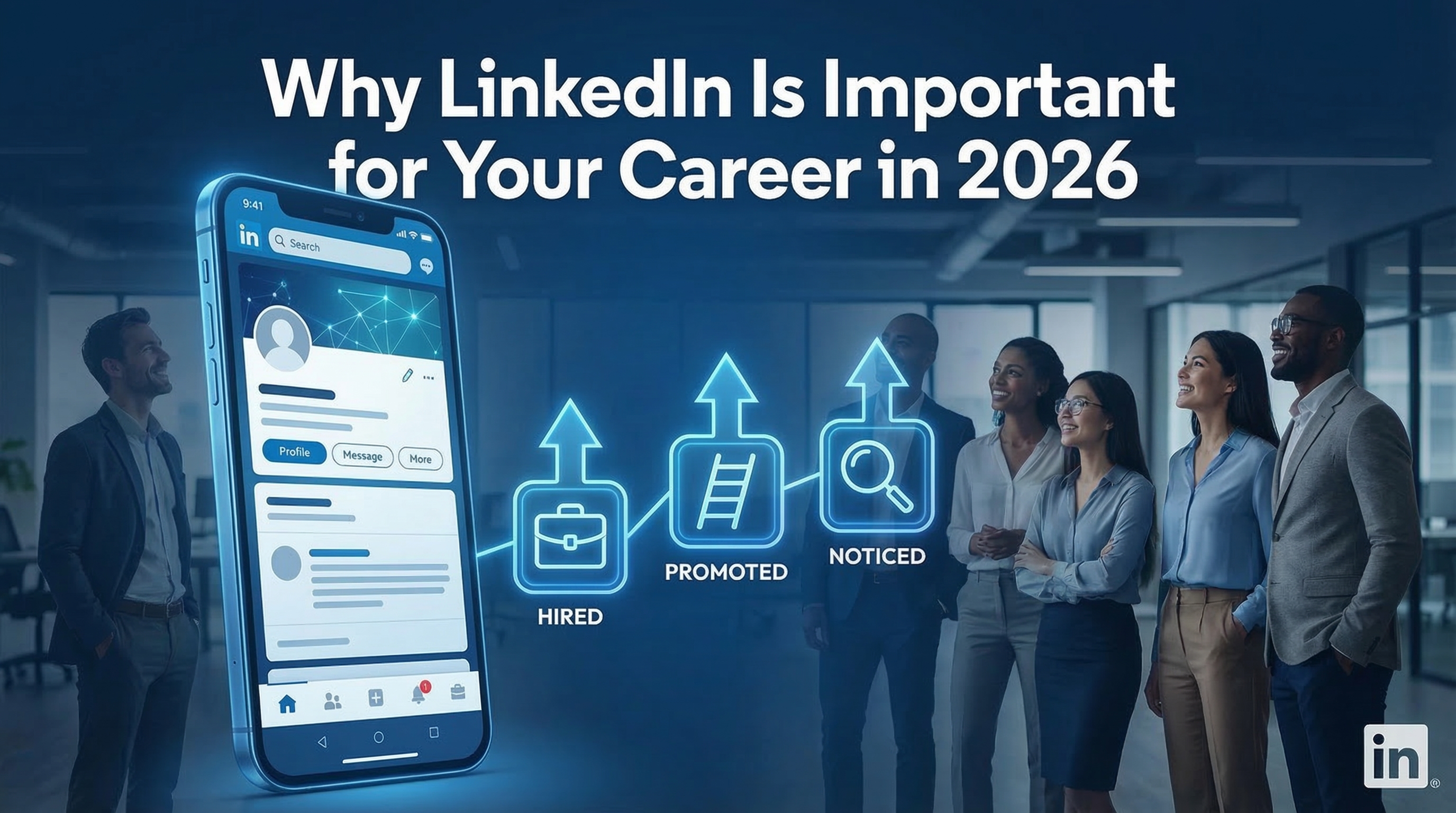
There was a time when LinkedIn was a digital Rolodex — a place to store your contacts and occasionally update your job title. That era is over. In 2026, LinkedIn is the world's most powerful professional platform, a job search engine, a publishing platform, a personal branding tool, and a recruitment marketplace all rolled into one. If you are serious about your career, ignoring LinkedIn is the equivalent of making yourself invisible to the professional world.
This guide will show you exactly why LinkedIn is important, how to use it strategically, and the specific actions that separate professionals who get noticed from those who get overlooked.
LinkedIn by the Numbers: Why It Matters in 2026
Before we dive into strategy, let the data speak for itself:
- 1+ billion members across 200+ countries and territories
- 67+ million companies have LinkedIn pages
- 87% of recruiters use LinkedIn as their primary sourcing tool
- 6 people are hired every minute through LinkedIn
- 61 million senior-level influencers and 40 million decision-makers are on the platform
- 49% of LinkedIn users earn more than $75,000 annually
- 8 people are hired every minute for jobs posted directly on LinkedIn
- Profiles with photos receive 21x more views and 9x more connection requests
- Members with 5+ skills listed receive up to 17x more profile views
These are not abstract statistics — they represent real career opportunities that flow through LinkedIn every single day. If your profile is weak, incomplete, or non-existent, you are missing out on a massive share of those opportunities.
The 7 Reasons LinkedIn Is Essential for Your Career
1. Recruiters Live on LinkedIn
The single most important reason LinkedIn matters is this: recruiters use it before every other platform. When a company needs to fill a role, the first thing most recruiters do is search LinkedIn — not job boards, not Google, not your portfolio website. LinkedIn is their primary database.
Here is what happens behind the scenes:
- Recruiters use LinkedIn Recruiter (a premium tool costing $8,000-$12,000/year per seat) to search for candidates by keywords, location, skills, experience, and current company
- They review your headline, summary, experience, skills, and recommendations before deciding whether to reach out
- If your profile is incomplete, keyword-poor, or has no photo, you will not appear in their searches — period
- Even when you apply through a company's career page, the hiring manager will Google you — and your LinkedIn profile is typically the first result
Bottom line: If you are not on LinkedIn, you do not exist to the majority of recruiters. If your profile is weak, you are invisible even if you are there.
2. It Is Your Professional Brand — 24/7
Your resume is a document you send when you apply for a job. Your LinkedIn profile is a living, breathing representation of your professional identity that works for you around the clock — even when you are not actively looking for a job.
A well-crafted LinkedIn profile:
- Establishes you as a credible professional in your field
- Showcases your achievements, endorsements, and recommendations from real people
- Positions you as a thought leader if you publish content regularly
- Attracts inbound opportunities — job offers, consulting gigs, speaking invitations, partnerships
- Creates a professional first impression for anyone who searches your name online
Think of LinkedIn as your professional storefront. Your resume is a brochure you hand out at meetings. Both matter, but only one is visible to the world at all times.
3. Networking at Scale
The old saying "It's not what you know, it's who you know" has never been more true — and LinkedIn makes "who you know" exponentially larger.
Traditional networking limits you to people you have physically met. LinkedIn removes that barrier entirely:
- Connect with professionals in your industry worldwide
- Follow and engage with leaders, companies, and influencers in your field
- Join industry-specific groups with thousands of active members
- Get warm introductions through mutual connections
- Attend LinkedIn Live events and virtual conferences
A single thoughtful comment on a CEO's post can put you on their radar. A connection request with a personalised message can start a relationship that leads to a job offer six months later. LinkedIn scales your networking in ways that are simply impossible offline.
4. The Hidden Job Market
An estimated 70-80% of jobs are never publicly advertised. They are filled through referrals, internal promotions, and recruiter outreach. LinkedIn is the gateway to this hidden job market.
Here is how:
- Recruiter InMails: Recruiters proactively reach out to candidates who match their search criteria — you never even need to apply
- "Open to Work" feature: Signals to recruiters (privately or publicly) that you are available, increasing InMail messages by up to 40%
- Employee referrals: When you are connected to employees at a company, they can refer you before a role is even posted publicly
- Hiring manager posts: Many managers post about open roles on their personal feed before the official job listing goes live. Following the right people gives you early access
If you only use job boards, you are competing for the 20-30% of roles that are publicly listed — against every other applicant. LinkedIn gives you access to the rest.
5. Social Proof and Credibility
In 2026, social proof is everything. When a recruiter or hiring manager reviews your candidacy, they do not just look at your resume — they look for evidence that other people vouch for you.
LinkedIn provides this through:
- Recommendations: Written testimonials from managers, colleagues, and clients that appear on your profile
- Endorsements: Colleagues validate your skills with a single click, and the count is visible to everyone
- Engagement: Comments, likes, and shares on your posts show that your ideas resonate with professionals in your field
- Follower count: A growing follower base signals influence and credibility
- Content history: Articles and posts you have published demonstrate expertise and thought leadership
A candidate with 15 recommendations and 500+ endorsements signals a strong professional reputation. A candidate with a bare profile and zero recommendations raises questions — regardless of how impressive their resume looks.
6. Learning and Professional Development
LinkedIn is not just a job platform — it is one of the world's largest professional learning ecosystems.
- LinkedIn Learning: Over 21,000 courses in business, technology, and creative skills. Certificates from completed courses appear on your profile automatically.
- Industry news and trends: Your feed delivers curated content from industry leaders, publications, and professionals you follow
- Peer insights: Learn from the real-world experiences others share in posts and articles
- Skill assessments: Take LinkedIn Skill Assessments to earn verified badges that appear on your profile — profiles with badges get 30% more InMails
By engaging with LinkedIn daily, you stay current in your field without subscribing to dozens of newsletters or attending every conference.
7. Career Intelligence and Market Awareness
LinkedIn gives you access to data and insights that were previously available only to recruiters and HR professionals:
- Salary insights: Research compensation ranges by role, location, and experience level
- Company insights: See hiring trends, employee count growth, recent hires, and company news
- Job market trends: LinkedIn's Economic Graph tracks hiring rates, in-demand skills, and migration patterns across industries
- Competitor analysis: See where professionals in your field work, what skills they have, and how they describe their experience
- Interview preparation: Research your interviewers before meetings — their background, shared connections, interests, and content they have published
How to Build a LinkedIn Profile That Attracts Recruiters
Having a LinkedIn account is not enough. The difference between a profile that attracts recruiter attention and one that gets ignored comes down to optimisation. Here is how to build a profile that works.
Professional Photo
This is non-negotiable. Profiles with professional headshots receive 21x more profile views and 9x more connection requests than those without. Your photo should be:
- A clear, well-lit headshot with your face occupying 60% of the frame
- Professional attire appropriate for your industry
- A neutral or simple background
- Recent (taken within the last 2 years)
- Smiling and approachable — you want people to want to work with you
Headline: Your Most Important Real Estate
Your headline is the first thing people see — in search results, connection requests, comments, and messages. The default is your job title and company, but you should customise it with keywords recruiters search for.
Weak headline: "Marketing Manager at ABC Corp"
Strong headline: "Marketing Manager | Digital Strategy & Growth Marketing | Driving Revenue Through Data-Driven Campaigns | B2B SaaS"
Include your core skills, specialisation, and industry. Think about what a recruiter would type into the LinkedIn search bar and make sure those words are in your headline.
About Section: Tell Your Story
The About section (formerly Summary) is your opportunity to tell your professional story in your own words. This is not a copy of your resume — it is a narrative that connects your experience, skills, and ambitions.
A strong About section should:
- Open with a compelling hook — what drives you professionally?
- Summarise your career trajectory and key achievements (with numbers)
- Highlight your core skills and areas of expertise
- Include relevant keywords naturally throughout
- End with a call to action — what are you looking for? How can people reach you?
- Be written in first person ("I lead..." not "John leads...")
- Be 3-5 paragraphs (1,500-2,000 characters is ideal)
Experience Section: Achievements, Not Duties
Just like your resume, your LinkedIn experience section should focus on achievements with measurable results — not job descriptions.
- Use bullet points for readability
- Start each bullet with a strong action verb
- Include metrics: revenue generated, costs saved, team size, percentage improvements
- Add media: presentations, reports, articles, or project links to each role
- Keep it current — an outdated profile signals disengagement
Skills & Endorsements
Add at least 10 relevant skills to your profile. Profiles with 5+ skills receive 17x more views. Pin your top 3 skills — these are the most visible. Actively endorse your connections' skills, and many will reciprocate.
Recommendations: The Gold Standard of Social Proof
Recommendations are the most powerful credibility signal on LinkedIn. Aim for at least 5-10 recommendations from managers, colleagues, and clients. To get them:
- Write a recommendation for someone first — they will often reciprocate
- Ask specific people with a personalised message: "Would you be willing to write a brief recommendation about our work on [specific project]?"
- Diversify: get recommendations from different roles, companies, and relationships (managers, peers, direct reports, clients)
LinkedIn Content Strategy: Becoming Visible
A complete profile gets you found. Content gets you remembered. Publishing on LinkedIn positions you as a thought leader and keeps you visible to your network — including recruiters.
What to Post
- Career lessons and insights: Share what you have learned from your professional experiences
- Industry trends and commentary: Add your perspective on news and developments in your field
- Project wins: Celebrate achievements (yours and your team's) with specific details
- How-to content: Share practical tips, frameworks, or processes that help others
- Personal career stories: Authentic posts about career pivots, challenges, and growth resonate strongly
- Engagement posts: Ask questions, run polls, or invite discussion on relevant topics
Posting Best Practices
- Frequency: 2-4 posts per week for consistent visibility
- Format: Mix text posts, image posts, document carousels (PDFs), and video. Carousels and images get 2-3x more engagement than text alone
- First line hook: LinkedIn shows only the first 2 lines before "See more." Make your opening line compelling enough to click
- Hashtags: Use 3-5 relevant hashtags to extend your reach beyond your network
- Engage others: Comment thoughtfully on other people's posts daily. This is as important as publishing your own content — it builds relationships and increases your visibility in the algorithm
- Best times to post: Tuesday through Thursday, between 7-9 AM or 12-1 PM in your target audience's time zone
The LinkedIn Algorithm in 2026
Understanding how LinkedIn's algorithm works helps you maximise reach:
- Posts are first shown to a small percentage of your network as a "test"
- If early engagement (likes, comments, shares within the first 60-90 minutes) is strong, the post is pushed to a wider audience
- Comments carry more weight than likes. Long, thoughtful comments carry more weight than short ones
- External links (to websites, YouTube, etc.) receive lower reach — LinkedIn wants to keep users on the platform
- Personal stories and authentic content consistently outperform corporate or promotional posts
- The algorithm rewards consistency — posting regularly matters more than going viral once
LinkedIn Networking: Building Relationships That Open Doors
Connection Strategy
- Quality over quantity: 500 meaningful connections are more valuable than 5,000 random ones
- Always personalise connection requests: A brief message explaining why you want to connect increases acceptance rates by 300%. Example: "Hi Sarah, I enjoyed your recent post about supply chain innovation. As a logistics professional, I would love to connect and follow your insights."
- Connect strategically: Recruiters in your industry, hiring managers at target companies, thought leaders, alumni from your university, and professionals in adjacent roles
- Engage before connecting: Comment on someone's posts a few times before sending a connection request. They will recognise your name and be more likely to accept
Leveraging Your Network for Job Searches
- Informational interviews: Reach out to people in roles you aspire to: "I admire your career path and would love 15 minutes of your time to learn about your experience at [Company]."
- Referrals: When you find a job opening, check if you have any 1st or 2nd-degree connections at the company. A referral can increase your chances of getting an interview by 5-10x.
- Alumni networks: Use LinkedIn's Alumni tool to find graduates from your university at companies you are targeting
- Engage hiring managers directly: Follow and engage with hiring managers at target companies. When a role opens, you will be a familiar name rather than a cold applicant
LinkedIn Features Most Professionals Overlook
Open to Work
Enable this feature to signal to recruiters that you are available. You can choose to make it visible to recruiters only (a discreet green banner visible only to LinkedIn Recruiter users) or to all LinkedIn members (the public green "Open to Work" photo frame). Profiles with "Open to Work" enabled receive 40% more InMails from recruiters.
Featured Section
Pin your best content, articles, external links, or media at the top of your profile. This is prime real estate — use it to showcase your best work, a portfolio piece, a published article, or a presentation.
Creator Mode
Activating Creator Mode changes your profile's default call-to-action from "Connect" to "Follow," gives you access to LinkedIn Live and newsletters, and signals that you are a content creator. If you post regularly, turn this on.
LinkedIn Newsletter
Once you activate Creator Mode, you can launch a LinkedIn Newsletter. Subscribers receive notifications for each issue — this is one of the most effective ways to build an engaged audience on the platform.
Skill Assessments
Take skill quizzes to earn verified badges that appear on your profile. Profiles with verified skills are 30% more likely to receive recruiter InMails. Available assessments include Excel, Python, JavaScript, project management, marketing, and dozens more.
LinkedIn Groups
Join 3-5 industry-specific groups. While groups are less active than they once were, they still provide value: job postings shared exclusively in groups, direct messaging to group members (even without being connected), and exposure to niche professional communities.
LinkedIn for Different Career Stages
Students and New Graduates
- Build your profile early — before you start job searching
- Highlight internships, projects, volunteer work, and academic achievements
- Connect with alumni from your university who work at target companies
- Follow companies you are interested in and engage with their content
- Use LinkedIn Learning to build and certify skills
Mid-Career Professionals
- Focus on achievements and measurable impact in your experience section
- Publish content that demonstrates your expertise
- Collect recommendations from managers and senior colleagues
- Build a network that includes recruiters, industry leaders, and potential mentors
- Keep your profile updated — even when you are not actively looking
Senior Executives and Leaders
- Your profile should reflect your leadership philosophy and strategic impact
- Publish thought leadership content regularly — it positions you as an industry voice
- Engage with C-level peers, board members, and industry analysts
- Use LinkedIn for executive visibility, speaking opportunities, and board positions
- Recommendations from other executives and board members carry significant weight
Career Changers
- Rewrite your headline and About section to reflect your target career, not your current one
- Emphasise transferable skills in your experience section
- Publish content related to your target industry to demonstrate knowledge and commitment
- Connect with professionals in your target field and request informational interviews
- Complete LinkedIn Learning courses and display certificates for your new skill set
Common LinkedIn Mistakes That Hurt Your Career
- No profile photo — Profiles without photos receive 21x fewer views. This is the single biggest mistake you can make.
- Default headline — "Marketing Manager at ABC Corp" tells recruiters nothing about your value. Customise your headline with keywords and specialisations.
- Empty About section — Leaving this blank wastes your most powerful storytelling real estate.
- Copy-pasting your resume — Your LinkedIn profile should complement your resume, not duplicate it. Use a more conversational, narrative tone.
- No activity — A profile with zero posts, comments, or engagement signals that you are not active on the platform. Even liking and commenting on others' posts counts.
- Connecting without personalising — Generic connection requests have low acceptance rates and make a poor first impression.
- Ignoring messages — Not responding to InMails, connection messages, or comments damages your professional reputation.
- Outdated information — An experience section that has not been updated in 2+ years tells recruiters you are disengaged.
- Complaining or negativity — Publicly criticising employers, colleagues, or companies on LinkedIn is a career killer. Keep your content professional and constructive.
- Not using keywords — If your profile does not contain the keywords recruiters search for in your field, you will not appear in search results — no matter how qualified you are.
LinkedIn vs. Other Platforms: Why It Wins for Careers
Best for: Professional networking, job search, personal brand
Recruiter use: 87% of recruiters
Career impact: Very High
Best for: Job listings and applications
Recruiter use: Moderate
Career impact: Medium
Best for: Industry conversations, tech community
Recruiter use: Low
Career impact: Low-Medium
Best for: Developer portfolios, open source
Recruiter use: Tech recruiters only
Career impact: High (tech only)
Best for: Creative portfolios, personal brand
Recruiter use: Very Low
Career impact: Low
No other platform combines job search, networking, content publishing, learning, and recruiter access in one place. LinkedIn is the only platform where every activity — from posting content to sending a connection request — directly contributes to your career growth.
Your LinkedIn Action Plan: Start Today
Here is your step-by-step checklist to build a LinkedIn presence that works for your career:
- Upload a professional headshot and customise your banner image
- Write a keyword-rich headline that goes beyond your job title
- Craft a compelling About section that tells your professional story
- Complete every experience entry with quantified achievements
- Add at least 10 relevant skills and take skill assessments for badges
- Request 5-10 recommendations from managers, colleagues, and clients
- Turn on "Open to Work" if you are actively job searching
- Set up your Featured section with your best work
- Post 2-4 times per week and engage with others' content daily
- Personalise every connection request you send
- Join 3-5 industry-specific groups
- Follow target companies and hiring managers
- Complete at least 3 LinkedIn Learning courses relevant to your career goals
- Review and update your profile every month
LinkedIn is not something you set up once and forget. It is a living professional presence that grows with your career. The professionals who invest 15-30 minutes daily in LinkedIn — optimising their profile, publishing content, engaging with their network — are the ones who receive the best opportunities.
Start today. Your next career opportunity might be one connection, one post, or one optimised headline away.
Ready to create a resume that matches your LinkedIn profile? Try our AI-powered resume builder to create a professional, ATS-optimised resume that complements your LinkedIn presence and helps you land more interviews.