The fastest-growing threat in hiring isn’t a skills gap — it’s a reality gap. Recruiters now field applications from candidates who don’t exist: AI-written resumes attached to stolen identities, and deepfake faces that smile through video interviews while someone else supplies the answers. What started as a fringe curiosity has become organized fraud, and it is quietly rewriting the hiring process for every honest job seeker.
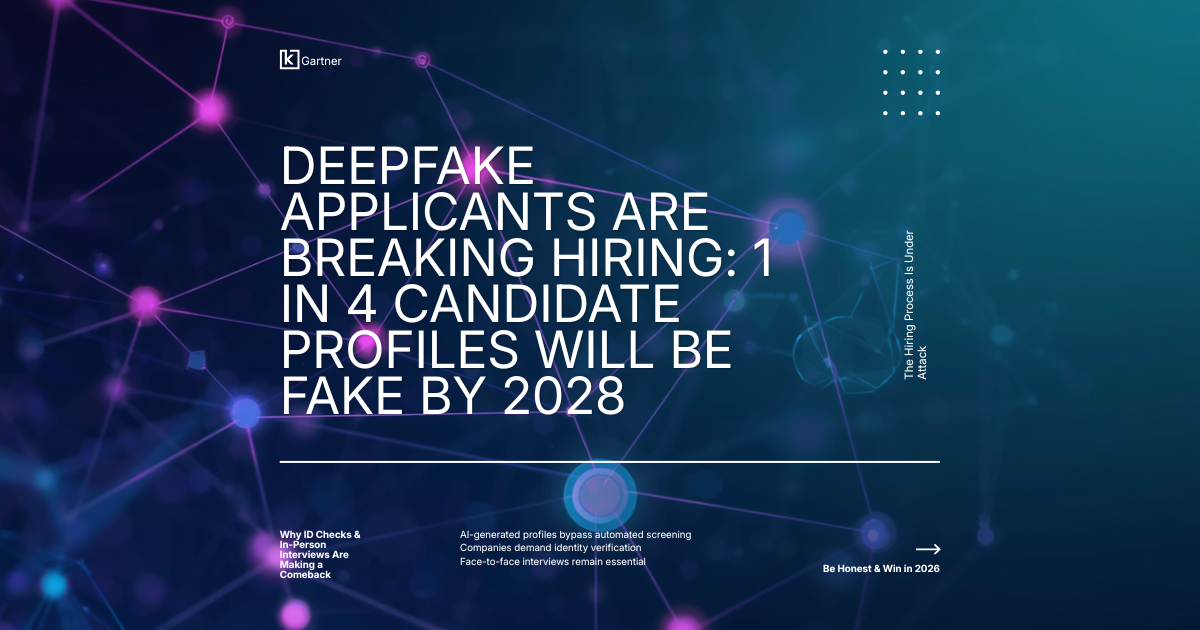
The numbers are hard to ignore. Gartner predicts that by 2028, 1 in 4 candidate profiles worldwide will be fake, according to reporting by HR Dive. In a 2Q 2026 Gartner survey of 3,000 job candidates, 6% admitted taking part in interview fraud — posing as someone else or having someone pose for them. A Resume Genius survey found 17% of hiring managers have encountered candidates using deepfake technology to alter their appearance in video interviews. And Gartner warns that by the end of 2026, about 30% of enterprises will find their standard identity-verification tools can no longer reliably tell a real face from a deepfake.
What Is Deepfake Candidate Fraud — and How Big Has It Become?
Deepfake candidate fraud is the use of AI-generated or AI-altered identity — a synthetic face on a video call, a cloned voice, a fabricated work history, or a real person’s borrowed credentials — to win a job the applicant could never earn as themselves. It goes far beyond polishing a job title. The modern version is a complete costume: face, voice, documents, and rehearsed answers, sometimes operated by a different person sitting off camera.
The fraud comes in tiers. At the low end, a real candidate quietly runs an AI assistant that feeds them answers mid-interview. In the middle, candidates hire stand-ins for technical rounds. At the top sit fully synthetic applicants: invented identities designed to collect a paycheck, plant malware, or quietly extract data once inside.
If Gartner’s 1-in-4 prediction holds, fake profiles will soon be common enough that employers must treat every unverified application as unproven by default. That shift — from trust-first to verify-first — is the biggest change honest candidates will feel in 2026.
Why Remote Hiring Opened the Door
Remote hiring opened the door because every stage of the process — application, screening, interview, even onboarding — can now be completed without anyone meeting the candidate face to face. A webcam feed can be filtered, a voice can be cloned, and a company laptop can be shipped to an address that has nothing to do with the person actually doing the work.
The most striking proof is organized crime, not lone opportunists. As CNBC has reported, North Korean IT-worker schemes placed fake employees inside U.S. companies using borrowed identities, on-camera stand-ins, and accomplices running laptop farms on American soil. Nobody in the hiring chain ever met the “employee” — and the paychecks flowed for months.
Once that playbook became public, employers stopped treating remote hiring as a solved problem. The verification wave you’re experiencing now is the direct response.
How Employers Are Fighting Back: The New Verification Stack
Employers are fighting back with a layered verification stack that confirms who you are before, during, and after the interview. You should expect to meet some or all of these layers in 2026:
- Pre-interview ID verification — matching a government-issued ID to your live face before a recruiter ever speaks with you.
- Camera-on liveness checks — quick prompts such as turning your head or reading a phrase aloud, designed to defeat face swaps and filters.
- Live skills assessments — real-time tasks that cannot be pre-recorded, scripted, or outsourced.
- Onsite final rounds — the in-person handshake is back for the last stage of serious offers.
Recruiters also increasingly cross-check your LinkedIn history and wider digital footprint against your resume, hunting for timelines that don’t line up. Much of this screening is run by algorithms, so it’s worth learning how AI interview screening works on the employer’s side. Trust cuts both ways, though: in its July 2026 press release, Gartner reported that only 26% of job applicants trust AI to evaluate them fairly — which is exactly why employers are layering human, in-person checks on top.
The New Normal for Honest Candidates, Stage by Stage
For honest candidates, the new normal means extra checkpoints at every stage of the funnel — and none of them should worry you if your story is real. Knowing what’s coming turns an interrogation into a routine. Here’s the path from application to offer:
- Application. Keep names, dates, employers, and titles identical across your resume, LinkedIn profile, and portfolio. In a verify-first market, mismatches read as red flags rather than typos.
- Screening. Expect identity-confirmation emails, callback phone screens, and recruiters quietly comparing your digital footprint with your claims before you hear anything back.
- Interview. Plan for camera-on calls, liveness prompts, and unscripted follow-up questions. Our guide to remote video interview preparation covers the lighting, setup, and live-answer habits that make you look composed rather than coached.
- Offer. Background checks, document re-verification, and increasingly an onsite final round now sit between the verbal yes and the signed contract.
How to Turn Verification Into Your Advantage
You turn verification into an advantage by treating every checkpoint as a chance to prove what impostors can’t — because every fraudster filtered out of the pipeline makes your genuine credentials more valuable. Candidates already sense this: the same Gartner research found 62% of candidates say they are more likely to apply when the organization requires in-person interviews. A verified process signals a serious employer — and a shortlist you actually want to be on.
Keep One Consistent Story Everywhere
Audit your resume, LinkedIn, and portfolio until they tell one identical story — same titles, same dates, same locations. Recruiters now read consistency as credibility, and small contradictions cost real interviews.
Say Yes to Live Proof
When an employer proposes a live skills assessment, accept enthusiastically. Real ability shines in real time, and every live task you complete separates you from the deepfakes and the answer-feeders. Treat liveness checks the same way: minor friction, major differentiation.
What Not to Do in the New Verification Era
Don’t let AI whisper answers in your ear during interviews, and never let someone else interview in your place — both are increasingly detectable, and both are career-enders. One interview-integrity platform flagged 38.5% of candidates for AI-assisted cheating across 19,368 live interviews tracked between July 2026 and January 2026. Detection systems watch eye movement, audio latency, and answer cadence, and they improve every quarter.
Remember that 6% of candidates in Gartner’s survey admitted to interview fraud — those are precisely the people the verification stack was built to catch, and getting flagged can follow you across shared screening platforms. Using AI to prepare is still completely fair: practice answers, research the company, polish your resume. The line is real-time deception about who you are and what you know.
The Bottom Line
Deepfake applicants broke trust-based hiring, and verification-first hiring is the repair. For honest candidates, the new checkpoints are not obstacles — they are a moat that keeps impostors away from your offer letter. Show up as yourself, keep your paper trail consistent, and embrace every chance to prove your skills live, because the math now favors the real. Start with the foundation: build a resume that matches your real, verifiable experience with Clever CV’s AI resume builder.