AI Is Now the First Person You "Meet" in a Job Search
In 2026, the first decision-maker in your job application is rarely a human. An applicant tracking system parses your resume, a model ranks you against a job description, and increasingly an AI agent runs your first interview. According to Greenhouse's 2026 Candidate AI Interview Report, 63% of job seekers have already experienced an AI interview — a jump of 13 percentage points in just six months. That report surveyed 2,950 active job seekers across the US, UK, Ireland, Germany, and Australia.
This guide explains exactly how AI screening works in 2026, what the verified research says about how recruiters actually use it, and the concrete steps you can take to pass automated filters while still reading as a real, credible human on the other side.
Stage 1: The Resume Screen (ATS + AI Ranking)
Before a person ever sees your application, software does. Roughly 98% of Fortune 500 companies use an applicant tracking system, according to Jobscan. The ATS extracts your text, maps it to fields, and scores your relevance to the role. Volume is part of why automation took over: LinkedIn has reported a record of roughly 11,000 job applications submitted per minute, so no human team can read every resume by hand.
Here is the trap many candidates fall into in 2026: they let a chatbot write the whole resume. Recruiters notice. A TopResume survey of 600 U.S. hiring managers (reported by the U.S. Chamber of Commerce CO—) found that 33.5% of hiring managers say they can detect an AI-generated resume quickly, often within about 20 seconds. About 20% would reject a candidate whose resume or cover letter was AI-generated, and a similar share treat heavy AI reliance as a red flag.
The good news is that the same survey found 52% of hiring managers accept AI for proofreading or drafting — as long as the final result reads as genuinely human. In other words, AI is a fine assistant and a poor ghostwriter. Use it to tighten phrasing and catch errors, then make every bullet specific to you.
How to pass the resume screen
- Mirror the job description's real keywords — exact tool names, certifications, and skills — but only ones you actually have.
- Use a clean, single-column layout with standard headings so the ATS can parse every field.
- Quantify your own results with numbers you can defend in an interview, not invented metrics.
- Edit out generic AI phrasing. If a sentence could describe anyone, rewrite it so it could only describe you.
Stage 2: The AI Interview
The AI interview is the fastest-growing part of screening. With 63% of job seekers already having faced one (Greenhouse, 2026), you should assume your first interview may be conducted by software — a one-way video prompt, an asynchronous voice agent, or a chat-based assessment. Greenhouse's own framing is blunt: most candidates who have had an AI interview have not yet had a good one, so the experience still feels unnatural to most people.
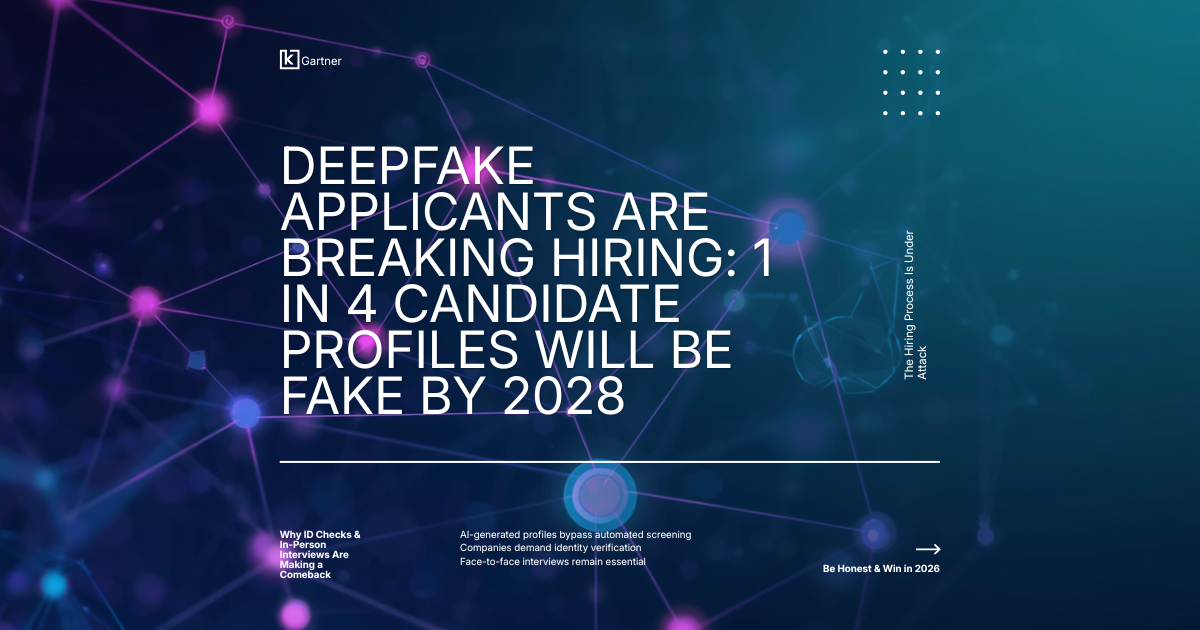
Candidate trust in these tools is low. A Gartner survey of 3,000 candidates found that only 26% of applicants trust AI to evaluate them fairly, and 62% say they are more likely to apply when an employer requires in-person interviews. That same research warns of a rising authenticity problem: Gartner projects that by 2028 about 1 in 4 (25%) candidate profiles will be fake, and 6% of candidates admitted to some form of interview fraud — which is exactly why employers are leaning harder on verification.
How to perform in an AI interview
- Speak in complete, structured answers. Use a clear format (situation, action, result) because models reward coherent, on-topic responses.
- Repeat key terms from the question naturally so the system maps your answer to what it is scoring.
- Treat the camera as a person. Steady pacing, eye contact with the lens, and a quiet background all help on one-way video.
- Be yourself, verifiably. With fake profiles rising, authentic, specific stories about your real work are your advantage.
Stage 3: The Market You're Competing In
It helps to know the landscape. Entry-level candidates face the toughest squeeze. The Stanford Digital Economy Lab's study "Canaries in the Coal Mine?" found that early-career workers aged 22–25 in the most AI-exposed occupations saw a 16% relative decline in employment since generative AI adoption, while experienced workers and less-exposed fields stayed stable or grew. If you are early in your career, expect more competition and lean harder on demonstrable, hands-on experience.
The process is also noisier than it looks. According to Greenhouse's 2024 State of Job Hunting report, between 18% and 22% of postings on the platform each quarter are "ghost jobs," 61% of job seekers have been ghosted after an interview, and 79% report heightened job-market anxiety. Not every silent rejection is about you — sometimes the role was never really open.
One more shift worth understanding: the "skills over degrees" promise has been slower than headlines suggest. Research from Harvard Business School's Joseph Fuller and the Burning Glass Institute found that at large firms that publicly dropped degree requirements, fewer than 1 in 700 hires actually changed, with non-degree hiring rising only about 3.5 percentage points. Skills still matter enormously — but lead with demonstrated skills rather than assuming a dropped degree requirement changes who actually gets hired.
Your 2026 Survival Checklist
- Write the resume yourself; let AI polish it. Aim for the human-sounding result the 52% of accepting recruiters want.
- Tailor to each role's real keywords so the ATS ranks you, without keyword-stuffing.
- Practice for AI interviews with structured, spoken answers and a calm on-camera presence.
- Prove you are real with specific, verifiable accomplishments — the antidote to a market worried about fake profiles.
- Protect your morale. Ghost jobs and silence are common; track applications and keep moving.
AI screening is not going away, but it rewards exactly what good candidates already have: clarity, relevance, and authenticity. Build a resume that a machine can read and a human can believe, and you will pass both gatekeepers in 2026.