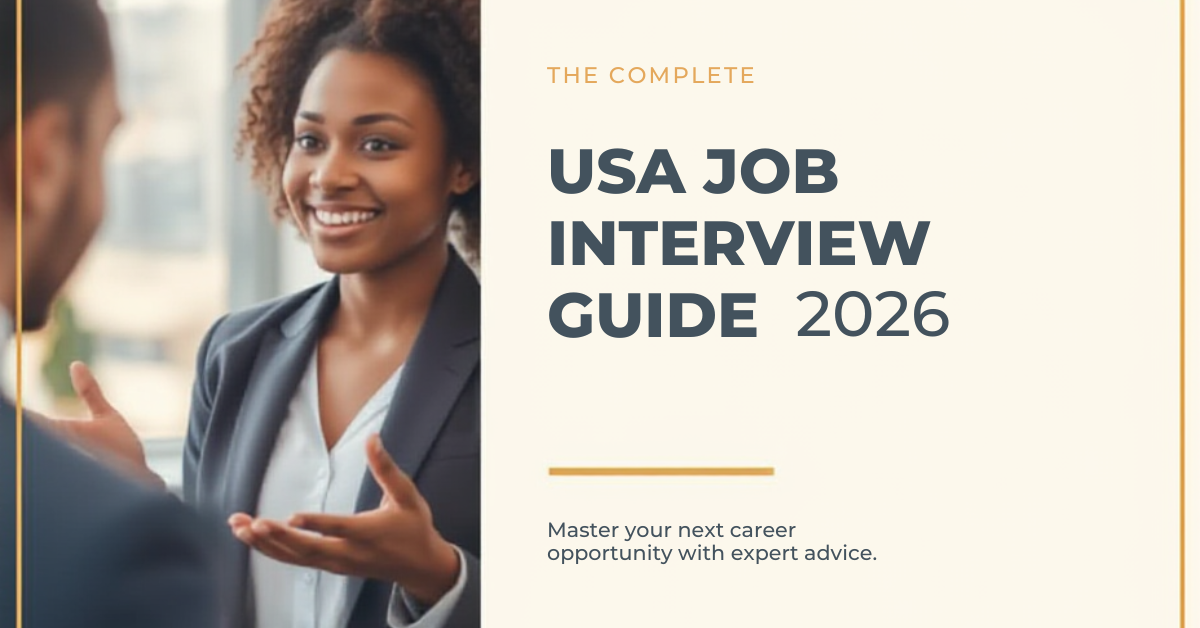
The American job market in 2026 presents unprecedented opportunities for job seekers worldwide. With over 11.3 million job openings across the United States and unemployment at historic lows of 3.7%, understanding the US interview process has never been more critical. This comprehensive guide covers everything you need to know to succeed in American job interviews.
Understanding the US Job Interview Landscape in 2026
The American hiring process has evolved significantly, driven by technological advances, changing workplace dynamics, and lessons learned from recent years. According to the Bureau of Labor Statistics, companies are now filling positions 23% faster than in 2023, yet 76% of hiring managers report difficulty finding qualified candidates who interview well.
Key Statistics for 2026
- Average time to hire: 36 days (down from 44 days in 2023)
- Virtual interview adoption: 82% of first-round interviews are conducted remotely
- AI screening: 67% of Fortune 500 companies use AI to screen initial applications
- Skills-based hiring: 45% of US employers have dropped degree requirements for many roles
- Average interviews before hire: 3.2 rounds
The Modern US Interview Process: What to Expect
Stage 1: Application and AI Screening
Your first hurdle is the Applicant Tracking System (ATS). In 2026, 98% of Fortune 500 companies and 66% of mid-sized US businesses use ATS software to filter applications. Key insights:
- Average ATS rejection rate: 75% of applications never reach human eyes
- Keyword matching is critical—tailor your resume to each job description
- Many systems now use AI to assess cultural fit based on application language
- Video resume submissions have increased by 340% since 2023
Stage 2: Phone/Video Screening (15-30 minutes)
If your application passes initial screening, expect a brief call from a recruiter or hiring manager. Purpose:
- Verify basic qualifications and employment eligibility
- Assess communication skills and professionalism
- Discuss salary expectations (be prepared with market research)
- Confirm interest and availability
Pro Tip: According to LinkedIn's 2026 Hiring Report, candidates who ask thoughtful questions during screening calls are 34% more likely to advance to the next round.
Stage 3: Technical/Skills Assessment
Many US employers now include skills assessments before in-depth interviews:
- Tech roles: Coding challenges on platforms like HackerRank, LeetCode, or company-specific tests
- Marketing/Creative: Portfolio reviews, case studies, or sample projects
- Sales: Role-play scenarios or presentation exercises
- Finance: Excel modeling tests or case analyses
Stage 4: In-Depth Interviews
American companies typically conduct 2-4 rounds of substantive interviews. These may include:
- Behavioral interviews: Using the STAR method (Situation, Task, Action, Result)
- Technical interviews: Deep-dive into your expertise
- Panel interviews: Multiple interviewers assess different competencies
- Culture fit interviews: Determining alignment with company values
- Executive interviews: For senior roles, meeting with C-level leadership
Top 50 Interview Questions Asked by US Employers in 2026
General/Behavioral Questions
- Tell me about yourself. (Asked in 94% of interviews)
- Why are you interested in this position?
- What do you know about our company?
- Where do you see yourself in five years?
- Why are you leaving your current job?
- What is your greatest professional achievement?
- Describe a challenging situation and how you handled it.
- Tell me about a time you failed and what you learned.
- How do you handle stress and pressure?
- Describe your ideal work environment.
Skills and Experience Questions
- Walk me through your resume.
- What makes you uniquely qualified for this role?
- Describe your experience with [specific skill/technology].
- How do you stay current in your field?
- What tools and software are you proficient in?
- Tell me about a project you're most proud of.
- How do you approach learning new skills?
- Describe your experience working with cross-functional teams.
- What relevant certifications do you hold?
- How do you measure success in your work?
Leadership and Teamwork Questions
- Describe your leadership style.
- Tell me about a time you led a team through a difficult situation.
- How do you motivate team members?
- Describe a conflict with a coworker and how you resolved it.
- How do you give and receive feedback?
- Tell me about a time you had to influence someone without authority.
- How do you build relationships with remote team members?
- Describe your approach to delegating tasks.
- How do you handle disagreements with your manager?
- Tell me about mentoring or coaching others.
Problem-Solving and Critical Thinking
- How do you approach complex problems?
- Describe a time you made a decision with incomplete information.
- Tell me about an innovative solution you implemented.
- How do you prioritize competing deadlines?
- Describe a situation where you had to think outside the box.
- How do you evaluate risks when making decisions?
- Tell me about a process you improved.
- How do you handle ambiguity in your work?
- Describe your analytical process.
- How do you approach data-driven decision making?
Company-Specific and Role Questions
- What interests you about our industry?
- How would you approach your first 90 days?
- What questions do you have for us?
- What would you change about our product/service?
- How do you see this role evolving?
- What's your understanding of our competitive landscape?
- How would you contribute to our company culture?
- What concerns do you have about this position?
- How does this role fit into your career goals?
- What would make you decline an offer from us?
Salary Negotiation in the US: 2026 Data and Strategies
Current Salary Ranges by Industry (2026)
Understanding market rates is essential for effective negotiation. Here are median salaries across major US industries:
💻 Technology
🏦 Finance
🏥 Healthcare
📢 Marketing
⚙️ Engineering
💼 Sales
Regional Salary Variations
Location significantly impacts compensation in the US. Cost-of-living adjustments for major markets:
- San Francisco Bay Area: +45% above national average
- New York City: +38% above national average
- Seattle: +32% above national average
- Los Angeles: +25% above national average
- Boston: +28% above national average
- Austin: +15% above national average
- Denver: +12% above national average
- Remote positions: Often based on company headquarters or national median
Negotiation Strategies That Work
1. Research Thoroughly
Use multiple sources: Glassdoor, Levels.fyi, LinkedIn Salary Insights, PayScale, and industry reports. Know your market value before any compensation discussion.
2. Let Them Make the First Offer
When asked about salary expectations, respond: "I'm focused on finding the right fit. Could you share the budgeted range for this position?" Studies show candidates who receive the first offer negotiate 7% higher final salaries.
3. Consider Total Compensation
US compensation packages include more than base salary:
- Annual bonus (typically 10-30% of base)
- Stock options or RSUs (especially in tech)
- 401(k) matching (average 4-6% employer match)
- Health insurance (employer-paid premiums average $7,500/year)
- Signing bonus (common in competitive fields)
- Relocation assistance
- Professional development budget
- Remote work flexibility
4. Use Data to Justify Your Ask
Frame requests with evidence: "Based on my research and the scope of this role, I was expecting a base salary in the range of $X-$Y. Given my experience with [specific skill] and my track record of [achievement], I believe $Y reflects my value."
5. Get Everything in Writing
Request a formal offer letter detailing all components before accepting. Verbal agreements are not binding in US employment contexts.
American Workplace Culture: What International Candidates Must Know
Communication Style
American business communication tends to be:
- Direct: Say what you mean clearly and concisely
- Positive: Frame challenges as opportunities
- Self-promoting: Speaking about achievements is expected, not arrogant
- Informal: First names are typically used, even with executives
- Action-oriented: Focus on solutions and next steps
Interview Etiquette
- Punctuality: Arrive 10-15 minutes early (or log in 5 minutes early for virtual)
- Dress code: Business professional unless told otherwise; tech companies are more casual
- Eye contact: Maintain consistent but not aggressive eye contact
- Handshake: Firm, brief handshake at introduction (post-pandemic etiquette: follow the interviewer's lead)
- Small talk: Be prepared for brief casual conversation before the formal interview
- Thank-you notes: Send within 24 hours; email is standard
Topics to Avoid
In American interviews, avoid discussing:
- Political opinions or religious beliefs
- Negative comments about previous employers
- Personal financial difficulties
- Health issues (unless relevant accommodation is needed)
- Salary in early interviews (let them bring it up)
Virtual Interview Best Practices for 2026
With 82% of initial interviews conducted virtually, mastering video calls is essential:
Technical Setup
- Camera: Position at eye level; ensure good lighting from the front
- Audio: Use quality headphones with microphone; test beforehand
- Internet: Use wired connection when possible; have mobile hotspot backup
- Platform: Download and test Zoom, Teams, Google Meet—whatever they use
- Background: Clean, professional space; virtual backgrounds are acceptable
Virtual Presence
- Look at the camera, not the screen, to simulate eye contact
- Use hand gestures naturally within the frame
- Nod and provide verbal acknowledgments ("Yes," "I see")
- Eliminate background noise and distractions
- Keep notes nearby but avoid obviously reading from them
Post-Interview Steps for US Job Seekers
The Thank-You Email (Critical)
Send within 24 hours. Include:
- Specific reference to conversation points
- Restatement of your interest and qualifications
- Any information you forgot to mention
- Clear next-step inquiry if not already defined
Template:
Subject: Thank You – [Position] Interview
Dear [Name],
Thank you for taking the time to discuss the [Position] role with me today. I enjoyed learning about [specific topic discussed] and am excited about the opportunity to contribute to [company goal/project mentioned].
Our conversation reinforced my enthusiasm for this position. My experience in [relevant skill] aligns well with your team's objectives, particularly [specific connection].
Please don't hesitate to reach out if you need any additional information. I look forward to hearing about the next steps.
Best regards,
[Your Name]
Following Up
- Wait until after their stated decision timeline
- One follow-up email is appropriate; avoid multiple contacts
- Keep the tone professional and positive
- Continue your job search while waiting
2026 Interview Trends Reshaping US Hiring
AI-Assisted Interviewing
34% of US companies now use AI tools in the interview process:
- AI-powered video analysis assessing confidence, engagement, and communication
- Chatbot initial screenings becoming more sophisticated
- Automated scheduling and candidate matching
- Real-time transcription and analysis of interviews
Skills-Based Hiring
The shift away from traditional credentials continues:
- 45% of US employers have eliminated degree requirements for many roles
- Portfolio reviews and work samples gaining importance
- Micro-credentials and certifications valued alongside traditional degrees
- Practical assessments replacing hypothetical questions
Emphasis on Soft Skills
Top soft skills US employers prioritize in 2026:
- Adaptability and resilience (78%)
- Communication across digital platforms (74%)
- Collaborative problem-solving (71%)
- Critical thinking and analysis (69%)
- Emotional intelligence (65%)
- AI and digital literacy (64%)
Conclusion: Your Path to Interview Success
The US job market in 2026 rewards candidates who combine technical competence with strong interpersonal skills, thorough preparation with authentic self-presentation, and ambition with cultural awareness. By understanding the American interview process, preparing for common questions, and presenting yourself confidently, you position yourself for success in one of the world's most dynamic job markets.
Remember: every interview is a two-way evaluation. While employers assess your fit for their organization, you're also determining if the role aligns with your career goals and values. Approach each opportunity with preparation, professionalism, and genuine curiosity.
Ready to create a resume that gets you interviews? Our AI-powered resume builder helps you craft the perfect application for US employers, optimized for ATS systems and tailored to American hiring preferences.