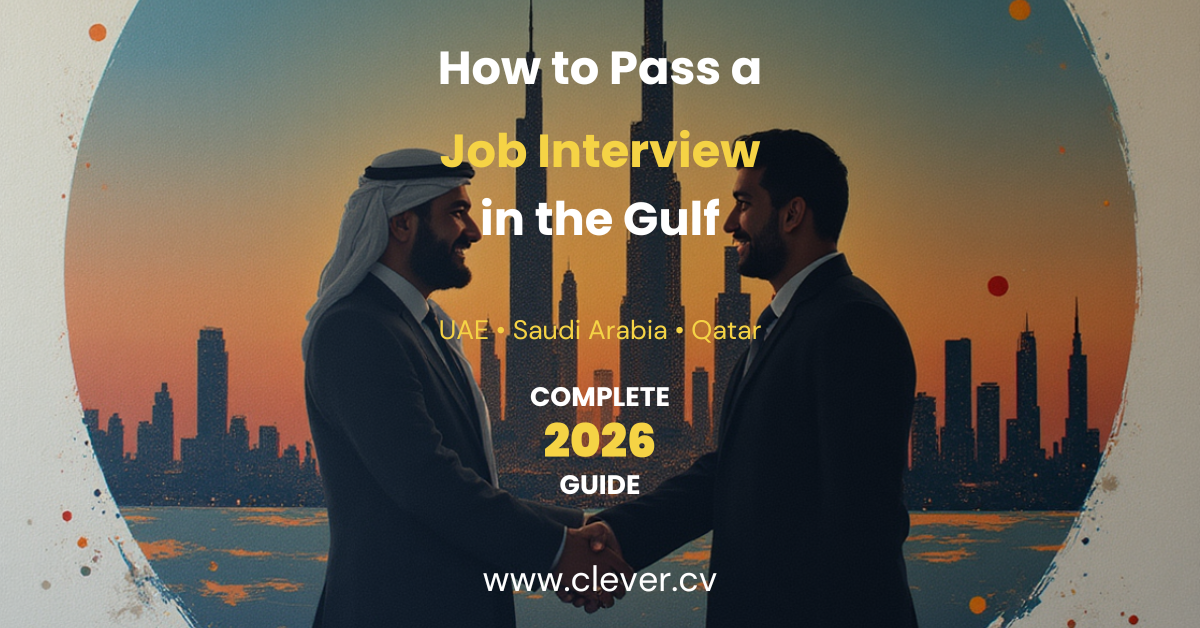
The Gulf Cooperation Council (GCC) countries — particularly the United Arab Emirates, Saudi Arabia, and Qatar — have become global magnets for ambitious professionals. With mega-projects like NEOM, Dubai's continued expansion, and Qatar's post-World Cup economic boom, the region offers tax-free salaries, rapid career growth, and an international lifestyle that attracts millions of expatriates from around the world.
But landing a job in the Gulf requires more than a strong CV. The interview process is shaped by unique cultural norms, business practices, and regulatory frameworks that differ significantly from Western markets. This comprehensive guide will prepare you for every aspect of the Gulf interview experience.
Understanding the Gulf Hiring Landscape
Key Market Differences
The Gulf job market has distinctive characteristics you must understand:
- Relationship-driven hiring: Personal connections (known as "Wasta" in Arabic) play a significant role. Networking and referrals are often more effective than cold applications.
- Expatriate workforce: In the UAE, expatriates make up nearly 90% of the workforce. In Saudi Arabia, this figure is around 75% in the private sector.
- Nationalization policies: Saudization (Nitaqat), Emiratization, and Qatarization require companies to hire minimum percentages of local citizens, affecting hiring quotas.
- Visa sponsorship: Your employer sponsors your work visa, residency permit, and often your family's visas. This creates a different dynamic than Western job markets.
- Tax-free salaries: The UAE, Qatar, and Saudi Arabia do not levy personal income tax, making gross salary equal to net salary.
The Typical Gulf Hiring Process
- Application: Through job portals (Bayt, GulfTalent, LinkedIn, Naukrigulf), recruitment agencies, or personal referrals
- Initial screening: Phone or video call with HR (often international recruiters based in the Gulf)
- First interview: With the hiring manager — may be via video if you are based overseas, or face-to-face if you are in the region
- Second interview: With senior leadership or the department head. For senior roles, this may include a meeting with the CEO or owner
- Offer and negotiation: A comprehensive package including base salary, housing, flights, insurance, and other benefits
- Visa processing: 2-8 weeks depending on the country and role
Cultural Etiquette: The Foundation of Gulf Interview Success
Cultural awareness is not just "nice to have" in the Gulf — it is a prerequisite for success. Employers actively assess your cultural sensitivity during interviews.
Greetings & First Impressions
- Handshake: A warm but not aggressive handshake is standard between men. When greeting someone of the opposite gender, wait for them to extend their hand first — some individuals prefer not to shake hands for religious or cultural reasons. A nod and a smile is always appropriate.
- Arabic greetings: Opening with "As-salamu alaykum" (Peace be upon you) shows cultural respect and is warmly received, even if the rest of the conversation is in English. The response is "Wa alaykum as-salam."
- Business cards: Present and receive business cards with your right hand or both hands. Take a moment to read the card before putting it away — this shows respect.
Communication Style
- Patience and warmth: Gulf interviews often begin with 5-10 minutes of personal conversation — family, your experience in the region, your impressions of the country. This is not small talk; it is relationship-building. Engage genuinely.
- Respect for hierarchy: Address senior people formally. Use "Sheikh," "Doctor," "Engineer," or their title when known. Titles matter in Gulf business culture.
- Indirect communication: In some contexts, especially with Emirati, Saudi, or Qatari interviewers, communication may be more indirect. Pay attention to nuance and avoid blunt or aggressive statements.
- Positive framing: Never criticize the country, its culture, religion, or government. This is a firm rule, not a suggestion.
Dress Code
- Men: A well-fitted dark suit with a tie. For senior-level meetings, a full suit is non-negotiable.
- Women: Conservative professional attire that covers shoulders, chest, and knees. A blazer over a blouse with trousers or a below-knee skirt is ideal. Avoid revealing, tight, or overly bright clothing.
- General: Quality grooming matters. Polished shoes, minimal but elegant accessories, and a well-kept appearance signal professionalism.
Top 20 Gulf Interview Questions & How to Answer Them
Professional & Experience Questions
- "Tell me about your experience and career journey." — Give a structured overview. Gulf employers value international experience and progressive career growth.
- "Why do you want to work in the UAE/Saudi Arabia/Qatar?" — Show genuine interest in the country, not just the tax-free salary. Mention the culture, growth opportunities, mega-projects, or lifestyle.
- "What do you know about our company?" — Research thoroughly. Know their projects, market position, ownership structure, and recent news.
- "Why are you leaving your current role?" — Frame it as seeking new challenges and growth. Never mention salary as the primary reason.
- "What is your management style?" — Emphasize adaptability. Gulf teams are often multicultural (20+ nationalities in one office), so cross-cultural leadership skills are highly valued.
Cultural Fit & Commitment Questions
- "How long do you plan to stay in the region?" — Gulf employers invest heavily in relocation and visa processing. They want commitment. Express your long-term interest (minimum 2-3 years).
- "Have you worked in a multicultural environment?" — Give specific examples of working with diverse teams. This is essential in the Gulf context.
- "How do you handle working in a hierarchical organisation?" — Show that you respect chain of command while being able to contribute ideas constructively.
- "Are you comfortable with the working hours and culture here?" — Gulf work schedules can differ. The UAE works Sunday to Thursday (some companies are shifting to Monday-Friday). Saudi Arabia works Sunday to Thursday. Ramadan brings shortened working hours.
- "Is your family supportive of the relocation?" — This is a common and legitimate question. Employers want to ensure you will settle and not leave after a few months due to family issues.
Technical & Situational Questions
- "Describe a major project you have led." — Use the STAR method. Emphasize scale, budget, team size, and measurable results.
- "How do you handle tight deadlines and pressure?" — Gulf projects often operate on aggressive timelines. Show you thrive under pressure with a real example.
- "Give an example of how you solved a conflict in a diverse team." — Highlight cultural sensitivity and diplomatic skills.
- "How would you contribute to our nationalization targets?" — Show awareness of Saudization/Emiratization/Qatarization. Discuss mentoring and developing local talent.
- "What is your experience with [industry-specific standards relevant to the Gulf]?" — Be prepared for region-specific technical questions (e.g., JAFZA regulations, ADNOC standards, Saudi Aramco requirements).
Compensation & Logistics
- "What is your expected salary package?" — Always discuss total compensation, not just base salary (see negotiation section below).
- "Do you have any existing visa or labour ban issues?" — Be transparent. Labour bans can affect your ability to transfer employers in the UAE.
- "When can you join?" — Factor in notice period (often 1-3 months), visa processing (2-8 weeks), and relocation logistics.
- "Do you have family who will be joining you?" — This affects the employer's benefits package. Be upfront about spouse and children.
- "Do you have any questions for us?" — Ask about team structure, company culture, growth plans, training opportunities, and the relocation process.
Salary Package Negotiation in the Gulf
Gulf compensation packages are fundamentally different from Western salaries. A "salary" in the Gulf is actually a comprehensive package with multiple components. Understanding each element is critical to negotiating effectively.
Components of a Gulf Salary Package
- Basic salary: The core monthly salary. Gratuity (end-of-service benefit) is calculated on this figure, so you want it to be as high as possible.
- Housing allowance: Typically 25-35% of the total package. May be provided as a cash allowance or company accommodation.
- Transportation allowance: Monthly car allowance, company car, or fuel reimbursement.
- Annual flights: Return economy or business class flights to your home country for you and your dependants (usually once per year).
- Health insurance: Medical coverage for you and your family. In the UAE, this is legally mandated.
- Education allowance: For senior roles, employers may contribute to children's school fees (international schooling can cost $10,000-30,000 per child per year).
- End-of-service gratuity: A lump sum payment when you leave the company, calculated based on your basic salary and years of service. In the UAE, this is 21 days of basic salary per year for the first 5 years and 30 days per year thereafter.
- Annual leave: Typically 22-30 working days depending on seniority and company policy.
- Bonus: Performance-based annual bonus (typically 1-3 months of salary for good performers).
Negotiation Tips
- Research the market: Use GulfTalent Salary Survey, Bayt Salary Calculator, Hays Gulf Salary Guide, and Robert Half Middle East Salary Guide.
- Negotiate the full package: Don't fixate on base salary alone. A lower base with better housing, education, and flight allowances can be more valuable overall.
- Ask about gratuity structure: Ensure your basic salary (on which gratuity is calculated) is a reasonable percentage of total compensation.
- Get everything in writing: Verbal promises are common in the Gulf, but your employment contract must detail every benefit. Do not accept an offer without a written contract.
- Understand the cost of living: Dubai and Abu Dhabi are expensive. Riyadh and Doha less so, but still significant. Factor housing, schooling, and lifestyle costs into your expectations.
Country-Specific Tips
United Arab Emirates (Dubai & Abu Dhabi)
- The most Westernized Gulf market — interviews are professional and relatively familiar
- English is the dominant business language
- Work week is Monday-Friday for most private sector companies (changed in 2022)
- Very competitive market — differentiate yourself with specific achievements and regional experience
- Free zones (DIFC, DMCC, JAFZA) have their own employment regulations
Saudi Arabia (Riyadh, Jeddah, NEOM)
- The largest Gulf economy, with Vision 2030 driving massive transformation
- Arabic is more widely used in government and some private sector environments
- Saudization (Nitaqat) has a significant impact on hiring — companies must meet quotas of Saudi nationals
- Dress code is more conservative. Women should dress modestly; an abaya is no longer legally required but is still worn in some workplaces
- NEOM and other mega-projects are creating thousands of new roles across engineering, technology, hospitality, and professional services
Qatar (Doha)
- Smaller but wealthy market with strong demand in energy, infrastructure, finance, and education
- Post-World Cup 2022 investment continues in tourism, entertainment, and infrastructure
- Qatarization policies require companies to hire Qatari nationals for certain roles
- English is widely used in business, though Arabic is beneficial for government-related work
- Qatar Foundation and its associated entities (universities, research centres) are major employers
Virtual Interviews for Gulf Roles
If you are interviewing from abroad, most initial interviews will be via video. Here is how to make them work:
- Time zones: Gulf Standard Time (GST) is UTC+4 (UAE, Qatar) and UTC+3 (Saudi Arabia). Schedule calls at times convenient for the interviewer.
- Platform: Microsoft Teams and Zoom are most common. Some employers use WhatsApp video for initial chats — this is normal in the Gulf, not unprofessional.
- Background and lighting: Professional, clean background. Good lighting on your face.
- Dress code: Full business attire, even for video calls. Gulf employers judge professionalism seriously.
- Connection: Ensure stable internet. Have a backup plan (phone call) ready.
Working with Recruitment Agencies
Recruitment agencies play a much larger role in the Gulf than in Western markets. Many companies exclusively hire through agencies for certain roles.
Top Gulf Recruitment Agencies
- Robert Half — Finance, technology, administrative
- Hays — All sectors
- Michael Page — Professional services, banking, engineering
- BAC Middle East — Executive recruitment
- Charterhouse — UAE-focused, multiple sectors
- Nadia Global — One of the largest Gulf recruitment firms
Tip: Register with 3-5 reputable agencies. Maintain regular contact with your recruiter. Never pay an agency to find you a job — legitimate agencies are paid by the employer.
Common Mistakes in Gulf Interviews
- Only mentioning the tax-free salary — Employers want to see genuine interest in the region, not just financial motivation.
- Ignoring cultural norms — Dress conservatively, greet appropriately, and show respect for local customs and religion.
- Not discussing long-term commitment — Companies invest significantly in your relocation. Show you are in it for the long haul.
- Negotiating only base salary — The package is what matters. A good housing allowance can be worth more than a salary bump.
- Being impatient with the process — Gulf hiring can be slower than Western markets. Decision-making often involves multiple stakeholders. Patience and polite follow-ups are key.
- Not having documents ready — Attested academic certificates, experience letters, and a valid passport are often required early in the process.
Conclusion: Your Gulf Interview Action Plan
The Gulf offers extraordinary career opportunities for professionals who approach the market with cultural intelligence and thorough preparation. Here is your checklist:
- Research the company, its projects, and the specific Gulf market you are targeting
- Prepare 8-10 STAR stories with emphasis on multicultural teamwork, leadership, and large-scale project delivery
- Understand the cultural etiquette — greetings, dress code, communication style
- Learn basic Arabic greetings to show respect
- Dress conservatively and professionally
- Negotiate the total package, not just the base salary
- Express genuine long-term commitment to the region
- Get everything in the employment contract in writing
- Prepare your documents: attested certificates, experience letters, passport copies
- Be patient with the process and follow up politely
The Gulf region is building the future — and there is a role for talented professionals who come prepared. Follow this guide and you will position yourself for success in one of the world's most dynamic job markets.
Ready to create a CV that impresses Gulf employers? Try our AI-powered resume builder to create a professional, ATS-optimized CV tailored for the Middle East job market.