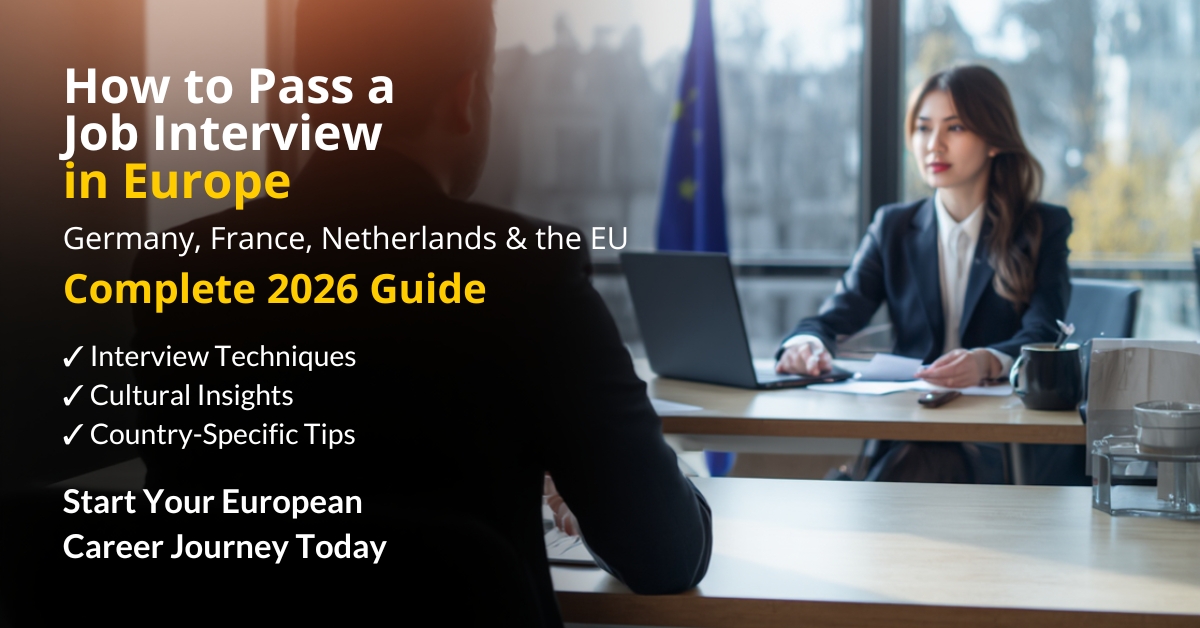
Europe is not one job market — it is a mosaic of 27 EU member states, each with its own interview culture, labour laws, language expectations, and professional norms. A strategy that works brilliantly in Amsterdam will fall flat in Paris. The approach that earns respect in Munich may seem cold in Madrid. Understanding these differences is not just an advantage — it is a requirement for any professional serious about building a career on the continent.
This comprehensive guide decodes the European interview landscape country by country, giving you the practical knowledge, cultural intelligence, and tactical strategies you need to land your ideal role in Europe in 2026.
Understanding the European Hiring Landscape
What Makes Europe Different
Before diving into country-specific advice, it is essential to understand the features that distinguish European job markets from the US, UK, or Gulf:
- Labour protections are strong: EU employment law provides robust worker protections — mandatory paid leave (minimum 20 days), parental leave, notice periods (often 1-3 months), and restrictions on at-will termination. This means employers hire more carefully and processes tend to be thorough.
- Work-life balance is a core value: Europeans take holidays seriously. Asking about work-life balance in an interview is not a red flag — it is expected and respected.
- Qualifications carry weight: In Germany, France, and other continental countries, formal education (degrees, diplomas, certifications) is valued more heavily than in the US or UK. Your academic credentials will be scrutinised.
- Language matters: While English is the business lingua franca at many multinationals, local language skills remain critical for most roles outside the tech startup ecosystem.
- Collective bargaining agreements (CBAs): In many European countries — France, Germany, the Nordics — salaries for entire sectors are set or guided by union-negotiated agreements. This affects both salary expectations and negotiation norms.
- The EU Blue Card: Non-EU nationals can access a streamlined work permit via the EU Blue Card, which requires a qualifying degree, a job offer, and a minimum salary threshold. This is Europe's equivalent of the US H-1B.
The Typical European Hiring Process
- Application: Through job portals (LinkedIn, Indeed, StepStone in Germany, Pôle Emploi in France, Werk.nl in the Netherlands), company career pages, or recruitment agencies
- CV screening: Your Lebenslauf (Germany), CV (Netherlands/Nordics), or lettre de motivation + CV (France) is reviewed. In many European countries, a professional photo on your CV is still expected (Germany, France, Austria, Switzerland)
- Initial screening: Phone or video call with HR — typically 20-30 minutes
- First interview: With the hiring manager, often 45-60 minutes. May include technical questions or a case study
- Second interview: With senior leadership or cross-functional team members. May include a presentation or assessment
- Offer, contract negotiation & onboarding: European employment contracts are detailed legal documents. Review them carefully
Country-Specific Interview Guides
Germany: Precision, Structure & Qualifications
Germany is Europe's largest economy and one of the most structured interview markets on the continent. German employers value thoroughness, expertise, and reliability above all.
Interview Culture
- Formality is high: Use "Sie" (formal you) unless explicitly invited to use "du." Address interviewers as Herr/Frau + surname. First names come later, if at all.
- Punctuality is non-negotiable: Arrive exactly on time — not 10 minutes early, not 1 minute late. In German business culture, punctuality signals competence and respect.
- Qualifications are scrutinised: German employers will verify your degrees, certifications, and job references in detail. Bring original documents and certified translations to your interview.
- Technical depth matters: Expect detailed questions about your technical knowledge, methodologies, and problem-solving approach. Vague or high-level answers will not impress.
- Direct communication: Germans appreciate straightforward, honest answers. Avoid excessive small talk or flowery language. Get to the point.
Key German Interview Questions
- "Erzählen Sie uns von Ihrem Werdegang" (Tell us about your career path) — Give a structured, chronological summary with clear logic for each career move.
- "Warum haben Sie sich bei uns beworben?" (Why did you apply here?) — Reference the company's reputation, products, market position, or values. Be specific.
- "Was sind Ihre Gehaltsvorstellungen?" (What are your salary expectations?) — Research via Kununu, StepStone Gehalt, or Glassdoor Germany. Provide a realistic range.
- "Wo sehen Sie sich in fünf Jahren?" (Where do you see yourself in five years?) — Show ambition but within realistic bounds. Germans value steady career progression over dramatic leaps.
- Technical deep-dive questions specific to your field — In engineering, IT, or manufacturing roles, expect detailed technical assessments.
Salary & Benefits
German salaries are competitive but vary by region. Munich and Frankfurt pay the highest; eastern German states pay less. The average annual gross salary is approximately €52,000. Senior professionals and engineers can expect €70,000-€120,000+. Benefits typically include 28-30 days holiday, employer pension contributions (Betriebliche Altersvorsorge), health insurance (mandatory), and often a company car for senior roles.
France: Personality, Prestige & the Art of Conversation
French interviews are a unique blend of professional assessment and personal evaluation. Your personality, education pedigree, and ability to engage in intelligent conversation matter as much as your technical skills.
Interview Culture
- Formality with warmth: Use "vous" (formal you) and address interviewers as Monsieur/Madame. French interviews are formal but often include genuine warmth, humour, and personal connection.
- Education matters enormously: Graduates of grandes écoles (HEC, Polytechnique, Sciences Po, ENA) enjoy significant hiring advantages. If you attended a prestigious institution, mention it early.
- The lettre de motivation: A cover letter is mandatory in France and is often handwritten for traditional companies (though typed is increasingly accepted). It follows a strict three-paragraph format.
- Personality assessment: French employers evaluate your intellectual curiosity, cultural awareness, and social skills. Being well-read, articulate, and thoughtful about your career choices will set you apart.
- French language is essential: Outside of international tech companies and some startup ecosystems, French fluency is required. Even at English-speaking companies, social interactions and meetings often default to French.
Key French Interview Questions
- "Présentez-vous" (Introduce yourself) — The French version is more holistic than "Tell me about yourself." Include education, career highlights, motivations, and a glimpse of your personality.
- "Pourquoi notre entreprise?" (Why our company?) — Show deep research. French employers appreciate candidates who understand their market position, history, and corporate culture.
- "Quels sont vos défauts?" (What are your weaknesses?) — French interviewers expect self-aware, nuanced answers. Avoid clichés. A thoughtful, honest response builds credibility.
- "Que lisez-vous en ce moment?" (What are you reading right now?) — This is more common in French interviews than anywhere else in Europe. Having a thoughtful answer demonstrates intellectual curiosity.
- "Quelle est votre prétention salariale?" (What is your salary expectation?) — Research via Glassdoor France, APEC, or Cadremploi. French salaries are often expressed as "brut annuel" (gross annual).
Salary & Benefits
French salaries include significant social contributions (charges sociales) that fund healthcare, pensions, and unemployment insurance. Net salary is typically 22-25% less than gross. The average gross salary for a cadre (professional/managerial) is approximately €50,000-€55,000. Benefits include 25 days holiday + RTT (additional rest days, often 10-15 extra), meal vouchers (Tickets Restaurant), 50% transport reimbursement, a 13th month bonus at many companies, and mandatory profit-sharing (participation/intéressement) at firms with 50+ employees.
The Netherlands: Direct, Egalitarian & Results-Focused
Dutch interview culture is famously direct and informal. The Netherlands offers one of Europe's most international and English-friendly job markets, making it a popular destination for non-Dutch speakers.
Interview Culture
- Directness is expected: Dutch people are famously direct. Answer questions honestly and concisely. Vague or overly diplomatic answers may be seen as evasive.
- Egalitarianism: The Dutch workplace is flat. Titles and hierarchy matter less than competence and contribution. Address interviewers by first name unless they indicate otherwise.
- English is widely spoken: The Netherlands has the highest English proficiency of any non-native-speaking country. Many companies — especially in Amsterdam, Rotterdam, and Eindhoven — conduct interviews entirely in English.
- Cultural fit is paramount: Dutch employers evaluate whether you will integrate well into the team. They value collaboration, openness, consensus-building (the famous "poldermodel"), and a healthy work-life balance.
- Cycling is a way of life: This is not a joke — if you mention cycling to work, it signals cultural adaptation. Dutch employers genuinely appreciate candidates who embrace local culture.
Key Dutch Interview Questions
- "Tell us about yourself and why you want to work here." — Be genuine and specific. The Dutch dislike rehearsed, corporate-sounding answers.
- "How do you handle disagreements with colleagues?" — Show that you communicate directly but respectfully. The Dutch value honest feedback.
- "What is your ideal work-life balance?" — This is a legitimate question. Describe your working style honestly — the Dutch respect boundaries.
- "Can you give an example of working in a diverse, international team?" — The Netherlands is highly international. Cross-cultural teamwork experience is valued.
- "What are your salary expectations?" — Research via Glassdoor Netherlands, Indeed Netherlands, or the Loonwijzer salary checker.
Salary & Benefits
Dutch salaries are competitive, especially in tech, finance, and energy. The average gross salary is approximately €44,000-€48,000. Senior professionals earn €65,000-€100,000+. The Netherlands offers a unique tax benefit for international workers: the 30% ruling, which exempts 30% of your gross salary from income tax for up to 5 years. Benefits typically include 25-27 holidays, employer pension contributions, travel allowance, and sometimes a lease car or bike plan.
The Nordics: Sweden, Denmark, Finland & Norway
Nordic interviews are among the most relaxed and egalitarian in Europe, but do not mistake informality for low standards.
- First names from the start: Hierarchy is minimal. You will likely address the CEO by their first name.
- Consensus and collaboration: Nordic employers value team players who can build consensus. Emphasise collaborative achievements over solo heroics.
- Work-life balance is sacred: Nordic countries consistently rank highest globally for work-life balance. Asking about flexible working, parental leave, and holiday policies is expected and encouraged.
- Fika culture (Sweden): The Swedish tradition of coffee breaks (fika) with colleagues is a core part of workplace culture. Showing awareness of this signals cultural fit.
- Language: English is widely spoken across the Nordics, especially in tech, finance, and international business. However, local language skills (Swedish, Danish, Finnish, Norwegian) are a significant advantage for long-term career growth and integration.
- Salary transparency: Nordic countries are moving toward full salary transparency. In many cases, salary ranges are published. Negotiation is modest — the range is the range.
Top 20 European Interview Questions & Expert Answers
Universal Questions Asked Across Europe
- "Walk me through your CV." — Give a chronological, logical narrative. In Europe, career consistency and progression are valued. Explain any gaps or transitions clearly.
- "Why are you interested in this role?" — Connect your skills and ambitions to the specific company and role. Show that you have researched their market, products, and culture.
- "Why do you want to work in [country]?" — If you are relocating, demonstrate genuine interest in the country beyond the job. Mention quality of life, culture, language learning, or long-term plans to settle.
- "What is your experience working in international or multicultural teams?" — Europe's workforce is deeply international. Give specific examples of cross-cultural collaboration.
- "Describe your approach to problem-solving." — Use a structured answer: define the problem, gather information, evaluate options, decide, implement, review. European employers value methodical thinking.
Competency & Behavioural Questions
- "Tell me about a time you managed a difficult project." — Use STAR. Emphasise planning, stakeholder management, and measurable results.
- "How do you handle disagreements with your manager?" — Show maturity and diplomacy. Europeans value constructive conflict resolution and respectful communication.
- "Give an example of adapting to a major change at work." — Demonstrate flexibility and resilience. Change management skills are highly valued in the evolving European market.
- "Describe a situation where you demonstrated leadership." — In Europe, collaborative leadership is preferred over authoritarian styles. Highlight how you enabled the team rather than just directed it.
- "How do you prioritise when everything is urgent?" — Describe your framework (time-boxing, impact/effort matrix, stakeholder alignment) with a concrete example.
Cultural Fit & Motivation Questions
- "What motivates you professionally?" — Be authentic. Europeans respect genuine answers over rehearsed corporate-speak.
- "How important is work-life balance to you?" — In Europe, this is not a trick question. Answer honestly and show that you respect boundaries while remaining committed to quality work.
- "Where do you see yourself in three to five years?" — Show realistic ambition. European career paths tend to be steady and incremental rather than the rapid jumps valued in the US.
- "What do you know about our company culture?" — Research Kununu (Germany), Glassdoor, and the company's LinkedIn presence. Reference specific values or initiatives.
- "How do you continue to develop professionally?" — Europeans value lifelong learning (Bildung in German culture). Mention courses, conferences, certifications, or reading habits.
Practical & Logistics Questions
- "What are your salary expectations?" — Research country-specific data. Express as gross annual (brut annuel in France, Bruttojahresgehalt in Germany). Provide a range.
- "What is your notice period?" — European notice periods are typically 1-3 months (sometimes 6 months for senior roles in Germany). Be transparent.
- "Do you have the right to work in the EU?" — If you are a non-EU citizen, explain your visa status clearly. Mention EU Blue Card eligibility if applicable.
- "Are you willing to learn the local language?" — If you do not speak the local language, show commitment to learning. Mention any courses you are taking or plan to take. This matters hugely in France and Germany.
- "Do you have any questions for us?" — Ask about team structure, company values in practice, professional development opportunities, and onboarding process. In Europe, asking about holiday days and remote work policies is perfectly normal.
European Interview Etiquette: Country-by-Country
Dress Code
- Germany: Conservative business attire. Suit and tie for corporate roles. Smart-casual for tech and startups, but always polished.
- France: Stylish and well-put-together. French employers notice quality clothing, good grooming, and personal presentation. Understated elegance over flashy brands.
- Netherlands: Smart-casual is the norm for most industries. A full suit may feel overdressed except in banking or law.
- Nordics: Clean, minimal, smart-casual. Scandinavians dress practically and without ostentation.
Communication Norms
- Germany: Direct and factual. Provide evidence for your claims. Small talk is brief.
- France: Conversational and exploratory. French interviewers enjoy intellectual discussion and appreciate nuanced thinking.
- Netherlands: Extremely direct. Do not take blunt questions or feedback personally — it is cultural, not personal.
- Nordics: Calm, measured, and consensus-oriented. Avoid boasting. Let your work speak for itself.
After the Interview
- A follow-up thank-you email is appreciated across Europe but is not as universally expected as in the US. Send one within 24-48 hours to differentiate yourself.
- European hiring processes are often slower than US ones. Expect 2-6 weeks between interview and offer. Be patient and follow up politely.
- In Germany, you may receive a formal letter (Zusage/Absage) rather than a phone call.
The EU Blue Card: Your Gateway to Working in Europe
The EU Blue Card is the primary work permit for highly skilled non-EU nationals. Understanding it is critical if you are interviewing from outside the EU.
Key Requirements
- Recognised degree: A university degree recognised in the EU member state where you are applying (some countries accept equivalent professional experience)
- Job offer: A binding employment contract or job offer from an EU employer
- Minimum salary: Varies by country — approximately €45,300 in Germany, €40,000 in the Netherlands, and €53,836 in France (2026 figures, check the latest thresholds)
- Employer sponsorship: Your employer initiates the process, but you are responsible for gathering documents
Benefits of the EU Blue Card
- Right to work in the issuing country with a path to permanent residency (typically after 21-33 months)
- Family reunification rights (spouse and children can join you)
- After 18 months, you can move to another EU member state under certain conditions
- Spouse receives unrestricted work authorisation in most countries
Tip for interviews: If you require an EU Blue Card, mention this proactively. Many European employers are experienced with the process, especially in Germany, the Netherlands, and France. Show that you understand the requirements and have your documents ready.
Salary Negotiation in Europe: The Smart Approach
Salary negotiation in Europe is more nuanced and restrained than in the US. Here is how to navigate it effectively:
Research First
- Germany: Kununu, StepStone Gehaltsrechner, Glassdoor Germany
- France: APEC, Cadremploi, Glassdoor France
- Netherlands: Glassdoor NL, Indeed NL, Loonwijzer
- Nordics: Glassdoor, Statistics Sweden (SCB), Statistics Norway (SSB)
Negotiation Principles
- Understand gross vs. net: European social contributions can reduce gross salary by 20-45% depending on the country. Always clarify whether the offered figure is gross or net.
- Negotiate the full package: Holiday days (can you get 30 instead of 25?), remote work days, pension contributions, education/training budget, relocation support, and bonus structure.
- Respect collective agreements: In sectors governed by CBAs (common in France, Germany, Nordics), individual salary negotiation is limited to the band defined by the agreement.
- The 30% ruling (Netherlands): If eligible, this tax benefit effectively increases your net salary by thousands of euros annually. Factor this into your calculation.
- 13th month salary: Common in France, the Netherlands, Spain, and Italy. Clarify whether the quoted annual salary includes or excludes the 13th month.
- Be professional, not aggressive: European employers respond well to data-driven, calm negotiation. Ultimatums and aggressive tactics will backfire.
Virtual Interviews for European Roles
- Time zones: Central European Time (CET, UTC+1) covers most of continental Europe. The UK is UTC+0. Factor this into scheduling.
- Platforms: Microsoft Teams dominates in European corporate environments. Zoom is common at startups and tech companies. Some French companies use proprietary platforms.
- Background: Professional and tidy. Europeans are generally less formal about virtual backgrounds than Americans, but avoid distracting environments.
- Dress: Match the formality of the country and role. A German corporate interview requires a suit on camera. A Dutch startup may expect smart-casual.
- Internet connection: Ensure a stable connection. European interviewers are understanding of minor technical issues but repeated disruptions leave a poor impression.
Common Mistakes in European Interviews
- Treating Europe as one market — Each country has distinct interview culture. A strategy that works in Amsterdam will not work in Paris. Do your country-specific research.
- Over-selling yourself (American style) — Most European cultures — especially German, Dutch, Nordic, and British — value evidence over claims. Show, do not tell.
- Ignoring language expectations — If the job posting is in the local language, the interview will be too. Do not assume English will be sufficient.
- Not understanding the local contract — European employment contracts are detailed legal documents. Understand probation periods (Probezeit in Germany, typically 6 months), notice periods, non-compete clauses, and benefits before signing.
- Rushing the process — European hiring timelines are longer than US ones. Showing impatience or pressuring for a quick decision will not endear you to European employers.
- Asking no questions — As everywhere, not asking thoughtful questions signals disinterest. Ask about team dynamics, company culture, development opportunities, and what success looks like in the role.
- Undervaluing work-life balance discussions — In Europe, discussing holiday days, flexible working, and personal time is normal and expected. Pretending you never take holidays will not impress — it will raise concerns about cultural fit.
- Ignoring photo and CV conventions — In Germany, France, and Austria, a professional photo on your CV is standard practice. Submitting a US-style resume without a photo or cover letter may disadvantage you.
Conclusion: Your European Interview Action Plan
Succeeding in a European interview requires cultural intelligence, thorough research, and an understanding that Europe is not one market but many. Here is your comprehensive checklist:
- Research the specific country's interview culture, dress code, and communication style
- Tailor your CV to local conventions (photo, format, cover letter style)
- Prepare 8-10 STAR stories emphasising collaboration, problem-solving, and measurable results
- Research salary ranges using country-specific tools and understand gross vs. net calculations
- Learn basic phrases in the local language — even "Guten Tag," "Bonjour," or "Goedemorgen" makes a positive impression
- Understand visa requirements (EU Blue Card, national work permits) and have your documents ready
- Practice answering questions at a measured pace — European interviews reward thoughtful, evidence-based responses over rapid-fire enthusiasm
- Negotiate the full package: salary, holidays, pension, remote work, education budget, relocation support
- Send a thank-you email within 24-48 hours
- Be patient with the timeline and follow up politely
Europe offers extraordinary career opportunities — world-class companies, strong worker protections, generous holiday allowances, and a quality of life that consistently ranks among the highest globally. The professionals who thrive here are those who invest in understanding the local culture and present themselves with competence, authenticity, and respect.
Ready to create a CV that meets European standards? Try our AI-powered resume builder to create a polished, ATS-optimised CV with country-specific formatting for the European job market.