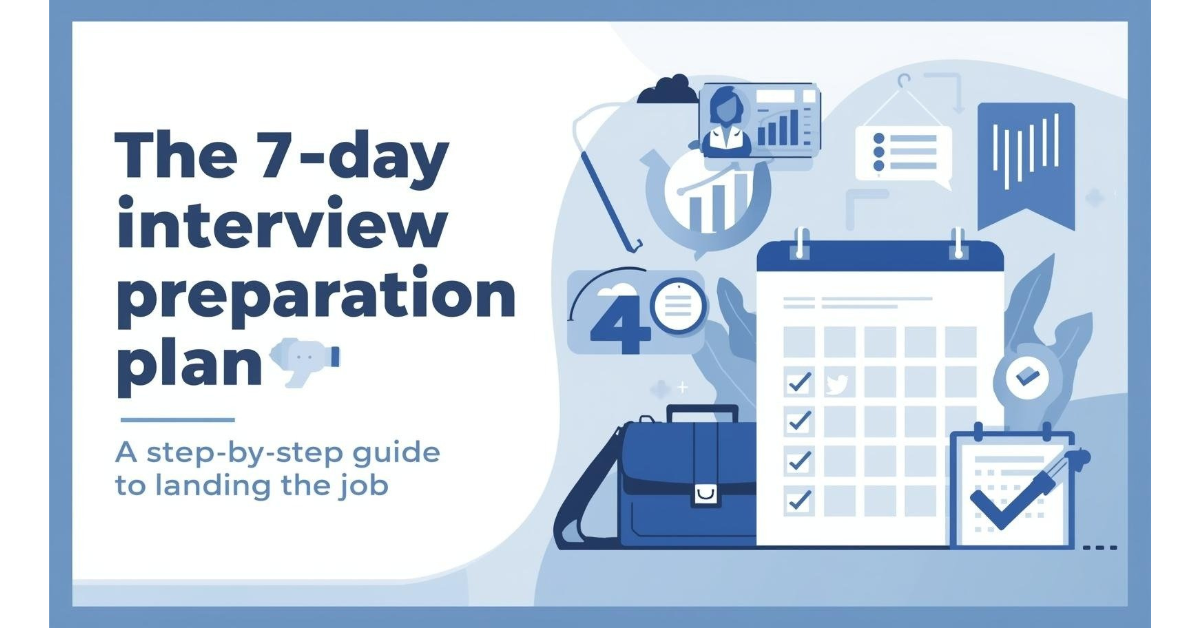
You just got the call — you have an interview scheduled for next week. The excitement kicks in, then the nerves. Where do you even start? Most candidates either over-prepare on random topics or barely prepare at all. Neither approach works.
What does work is a structured, day-by-day preparation plan that builds your confidence systematically. This 7-day guide breaks down exactly what to focus on each day so nothing falls through the cracks.
Why a Structured Approach Matters
In 2026, interviews have become more rigorous than ever. Companies use behavioral assessments, technical screens, and culture-fit evaluations — sometimes all in a single round. Candidates who prepare systematically outperform those who rely on talent alone.
Research shows that structured preparation reduces interview anxiety by up to 60% and significantly improves how clearly candidates articulate their experience. This plan gives you that structure.
Day 1: Deep Company Research
Your first day is all about understanding who you are interviewing with. Go beyond the "About Us" page.
What to Research
- Mission and values: Read the company's mission statement and recent press releases. Look for keywords they repeat — these signal what they care about most.
- Recent news: Check Google News, LinkedIn, and their blog for announcements from the past 3 months. Product launches, funding rounds, leadership changes — these are conversation gold.
- Industry position: Who are their competitors? What makes this company different? Understanding their market position helps you explain why this company, not just any company.
- Culture clues: Browse their social media, Glassdoor reviews, and team page. Look for patterns in how employees describe the work environment.
- Your interviewer: If you know who is interviewing you, review their LinkedIn profile. Note shared connections, interests, or career paths.
Day 1 deliverable: Write a one-paragraph answer to "Why do you want to work here?" that references specific things you discovered.
Day 2: Decode the Job Description
The job description is your cheat sheet. Every requirement listed is something they plan to ask about.
Break It Down
- Highlight the must-haves: Identify the top 5 skills or requirements mentioned. These are non-negotiable for the hiring manager.
- Match your experience: For each must-have, write down a specific example from your career that proves you have that skill.
- Spot the nice-to-haves: These are bonus points. If you have them, prepare examples. If not, think about how your transferable skills apply.
- Read between the lines: Phrases like "fast-paced environment" or "self-starter" tell you about the work culture and what kind of personality they want.
Day 2 deliverable: A skills matrix — a simple table matching each job requirement to your corresponding experience and a specific example.
Day 3: Master the STAR Method
Behavioral questions ("Tell me about a time when...") dominate modern interviews. The STAR method gives your answers a clear, compelling structure.
STAR Breakdown
- Situation: Set the scene in 1–2 sentences. When was this? Where were you working? What was the context?
- Task: What was your specific responsibility or challenge?
- Action: What did you do? Focus on your decisions, not the team's. Use "I" not "we." This is the longest part — 2–4 sentences.
- Result: What happened? Use numbers whenever possible. "Increased efficiency by 25%" is far more powerful than "things improved."
Prepare These 6 STAR Stories
Most behavioral interviews pull from the same themes. Prepare one strong STAR story for each:
- A challenge you overcame — Shows resilience and problem-solving.
- A time you led or influenced others — Even without a leadership title.
- A conflict you resolved — Demonstrates communication and maturity.
- A mistake you made and what you learned — Shows self-awareness.
- A time you exceeded expectations — Your highlight reel moment.
- A situation where you had to adapt quickly — Critical in today's fast-changing workplace.
Day 3 deliverable: Six written STAR stories, each under 90 seconds when spoken aloud.
Day 4: Tackle the Tough Questions
Some questions trip up even experienced candidates. Today you prepare honest, polished answers for the hardest ones.
Questions to Prepare
- "Tell me about yourself" — This is not your life story. Structure it as: Present (your current role and key strength) → Past (relevant background) → Future (why this opportunity excites you). Keep it under 90 seconds.
- "What is your greatest weakness?" — Name a real weakness, then immediately explain what you are doing to improve it. "I used to struggle with delegating tasks. I have been working on this by assigning ownership in our project management tool and checking in weekly instead of daily."
- "Why are you leaving your current job?" — Stay positive. Focus on what you are moving toward, not what you are running from. "I am looking for an opportunity to take on more strategic responsibility and grow into a leadership role."
- "What are your salary expectations?" — Research the market range on Glassdoor or Levels.fyi beforehand. Give a range based on your research: "Based on my experience and the market rate for this role, I am targeting $X to $Y."
- "Where do you see yourself in 5 years?" — Show ambition aligned with the company's growth: "I want to deepen my expertise in this area and eventually take on a senior or lead role where I can mentor others."
- "Do you have any questions for us?" — Always say yes. Prepare 3–5 thoughtful questions about the team, growth opportunities, or current challenges.
Day 4 deliverable: Written answers for all six questions above, rehearsed until they feel natural.
Day 5: Practice Out Loud
Reading your answers silently is not enough. Speaking them aloud rewires your brain for the real thing.
How to Practice Effectively
- Record yourself: Use your phone to record video answers. Watch for filler words ("um," "like," "you know"), fidgeting, and eye contact. Most people are surprised by habits they did not know they had.
- Time your answers: Most answers should be 30–90 seconds. If you are going over 2 minutes, you are losing the interviewer's attention.
- Practice with someone: Ask a friend, family member, or mentor to run through questions with you. Their feedback on clarity and confidence is invaluable.
- Try AI mock interviews: Tools like ChatGPT or specialized interview prep platforms can simulate realistic interview conversations and give instant feedback.
- Vary the order: Do not practice questions in the same sequence every time. In a real interview, questions come in unpredictable order.
Day 5 deliverable: Complete at least two full mock interviews (15–20 minutes each) and note your top 3 areas to improve.
Day 6: Prepare Your Logistics and Appearance
Nothing derails confidence like last-minute scrambling. Handle every logistical detail today.
Your Checklist
- Outfit: Choose your clothes today and try them on. Make sure everything fits, is clean, and is appropriate for the company culture. When in doubt, dress one level above the company's daily dress code.
- Documents: Print 3–5 copies of your resume on quality paper. Prepare a portfolio or work samples if relevant to the role.
- Route planning: For in-person interviews, do a test drive or check transit times for the exact interview time slot. Plan to arrive 10–15 minutes early.
- Tech check (virtual interviews): Test your camera, microphone, and internet connection. Ensure your background is clean and well-lit. Close unnecessary browser tabs and applications. Have a backup plan (phone hotspot, alternate device).
- Notes preparation: Bring a professional notebook with your prepared questions and key talking points. It is perfectly acceptable to reference notes during an interview.
- Emergency contacts: Save the recruiter's phone number and email in case you need to communicate last-minute changes.
Day 6 deliverable: Everything laid out and ready to go — zero decisions to make on interview morning.
Day 7: Rest, Review, and Visualize
The day before your interview is not for cramming. It is for calm, confident mental preparation.
Your Final Day Plan
- Morning — Light review: Read through your STAR stories and key answers one time. Do not memorize word-for-word — focus on the key points you want to hit.
- Afternoon — Visualization: Spend 10 minutes visualizing the interview going well. Imagine walking in confidently, answering questions clearly, and leaving feeling great. Athletes use this technique because it works.
- Evening — Relax: Do something you enjoy. Watch a movie, exercise, cook a good meal. Avoid last-minute preparation. Your brain needs rest to perform at its best tomorrow.
- Sleep: Aim for 7–8 hours. Set two alarms. Lay out your clothes and documents by the door.
Day 7 deliverable: A calm, confident mindset — you have done the work, and you are ready.
Interview Day: Quick Reminders
- Eat a proper breakfast — your brain needs fuel.
- Arrive 10–15 minutes early (or log in 5 minutes early for virtual).
- Greet everyone warmly — receptionists, other candidates, everyone.
- Listen carefully before answering. It is okay to pause for 2–3 seconds to collect your thoughts.
- Be specific in your answers. Vague answers are forgettable; specific stories stick.
- Ask your prepared questions — it shows genuine interest.
- Thank the interviewer and ask about next steps.
After the Interview: The Follow-Up
Within 24 hours, send a personalized thank-you email to each interviewer. Reference something specific from your conversation to show you were engaged. Keep it to 3–4 sentences — brief, warm, and professional.
If you do not hear back within the stated timeline, send one polite follow-up email. After that, continue your job search. The best candidates never stop preparing.
Final Thoughts
Interview preparation is not about memorizing perfect answers — it is about building the confidence to have a genuine conversation about your experience and potential. This 7-day plan gives you the structure to walk into any interview knowing you have covered every angle.
The candidates who win offers in 2026 are not necessarily the most qualified — they are the most prepared. Start your 7-day countdown today.